<?xml version="1.0" encoding="iso-8859-1"?>
<feed version="0.3" xmlns="http://purl.org/atom/ns#" xmlns:dc="http://purl.org/dc/elements/1.1/" xml:lang="en">
<title>Hyperstition</title>
<link rel="alternate" type="text/html" href="http://hyperstition.abstractdynamics.org/" />
<modified>2008-07-01T09:41:58Z</modified>
<tagline></tagline>
<id>tag:hyperstition.abstractdynamics.org,2008://23</id>
<generator url="http://www.movabletype.org/" version="2.661">Movable Type</generator>
<copyright>Copyright (c) 2008, Hyperstition</copyright>
<entry>
<title>Cyclonopedia | The End Draws Near</title>
<link rel="alternate" type="text/html" href="http://hyperstition.abstractdynamics.org/archives/010468.html" />
<modified>2008-07-01T09:41:58Z</modified>
<issued>2008-07-01T09:41:58Z</issued>
<id>tag:hyperstition.abstractdynamics.org,2008://23.10468</id>
<created>2008-07-01T09:41:58Z</created>
<summary type="text/plain"> Cyclonopedia (by Reza Negarestani) will be published soon by re.press. For more information about the book check the re.press website. New information will be posted here, once Cyclonopedia is available for ordering. &apos;Incomparable. Post-genre horror, apocalypse theology and the...</summary>
<author>
<name>Hyperstition</name>


</author>

<content type="text/html" mode="escaped" xml:lang="en" xml:base="http://hyperstition.abstractdynamics.org/">
<![CDATA[<p><img alt="Cyclonopedia-cover.jpg" src="http://hyperstition.abstractdynamics.org/archives/Cyclonopedia-cover.jpg" width="300" height="456" border="0" /></p>

<p>Cyclonopedia (by Reza Negarestani) will be published soon by re.press. For more information about the book check the <a href="http://www.re-press.org/content/view/58/40/">re.press website</a>. </p>

<p>New information will be posted here, once Cyclonopedia is available for ordering. </p>

<p>'Incomparable. Post-genre horror, apocalypse theology and the philosophy of oil, crossbred into a new and necessary codex.' (<b>China Miéville</b>, author of <i>Perdido Street Station</i> and <i>Scar</i>)</p>

<p>'Reading Negarestani is like being converted to Islam by Salvador Dali.' (<b>Graham Harman</b>, author of <i>Guerrilla Metaphysics: Phenomenology and the Carpentry of Things</i>)</p>

<p>(Follow the link below for more reviews.)<br />
</p>]]>
<![CDATA[<p>'It is rare when a mind has the courage to take our precious pre-conceptions of history, geography and language and turn them all upside down, into a living cauldron, where ideas and spaces become alive with fluidity and movement and breathe again with imagination and wonder. In this great novel by Reza Negarestani, we are taken on a journey that predates language and post dates history. It is all at once apocalyptic and a beautiful explosive birth of a wholly original perception and meditation on what exactly is this stuff we call "knowledge".' (<b>E. Elias Merhige</b>, director of <i>Begotten and Shadow of the Vampire</i>)</p>

<p>'This brilliant and exhilarating work is a forensic journey across the surface territories of the Middle East and into the depth of its sub-terrain. The earth is produced as a living artifact, gutted and hollowed out by nomadic war tactics, the practices of extreme archaeology and the logic of petroleum extraction. Inventing a radical new language and reconceptualizing the relationship between religion, geology, and ways of war, Reza Negarestani philosophically ungrounds thus the very grounds of contemporary middle-east politics.' (<b>Eyal Weizman</b>, author of <i>Hollow Land</i>)</p>

<p>'Cyclonopedia is an extraordinary tract, an uncategorizable hybrid of philosophical fiction, heretical theology, abberant demonology and renegade archeology. It aligns conceptual stringency with exacting esotericism, and through its sacrilegious formulae, geopolitical epilepsy is scried as in an obsidian mirror.' (<b>Ray Brassier</b>, author of <i>Nihil Unbound: Enlightenment and Extinction</i>)</p>

<p>'Reza Negarestani's Cyclonopedia is rich and strange, and utterly compelling. Ranging from the chthonic mysteries of petroleum to the macabre fictions of H. P. Lovecraft, and from ancient Islamic (and pre-Islamic) wisdom to the terrifying realities of postmodern asymmetrical warfare, Negarestani excavates the hidden prehistory of global culture in the 21st century.' (<b>Steven Shaviro</b>, author of <i>Doom Patrols</i>)</p>

<p>'The Cyclonopedia manuscript remains one of the few books to rigorously and honestly ask what it means to open oneself to a radically non-human life – this is a text that screams, from a living assemblage known as the Middle East, "I am legion." Cyclonopedia also constitutes part of a new generation of writing that refuses to be called either theory or fiction; a heady mixture of philosophy, the occult, and the tentacular fringes of Iranian culture – call it "occultural studies." To find a comparable work, one would have to look back to Von Junzt's Unaussprechlichen Kulten, the prose poems of Olanus Wormius, or to the recent "Neophagist" commentaries on the Book of Eribon.' (<b>Eugene Thacker</b>, author of <i>Biomedia</i> and <i>The Global Genome</i>)</p>

<p>'From the city of Poetry and Roses in Iran comes this bloody bypass surgery on the heart of darkness.' (<b>David Porush</b>, author of <i>Soft Machine: The Cybernetic Fiction</i>)</p>

<p>'Negarestani's Cyclonopedia meticulously plots the occult matrices of an archaic petrochemical conspiracy that has set the earth on its carbon-cycle feedback loop to Hell.' (<b>John Cussans</b>, Chelsea College of Art and Design)</p>

<p>'Western readers can expect their peculiarly schizoid condition to be "butchered open" by this work. [...] Read Negarestani, and pray.' (<b>Nick Land</b>, author of <i>The Thirst for Annihilation: Georges Bataille and Virulent Nihilism</i>)<br />
</p>]]>
</content>
</entry>
<entry>
<title>New posts and writings</title>
<link rel="alternate" type="text/html" href="http://hyperstition.abstractdynamics.org/archives/010455.html" />
<modified>2008-06-25T10:56:46Z</modified>
<issued>2008-06-25T10:56:46Z</issued>
<id>tag:hyperstition.abstractdynamics.org,2008://23.10455</id>
<created>2008-06-25T10:56:46Z</created>
<summary type="text/plain">Ben Noys on H.P.L., chaos and politics in three parts (1, 2, 3) Also, I am writing here too....</summary>
<author>
<name>R. Negarestani</name>
<url>http://www.cold-me.net</url>
<email>negarestani@cold-me.net</email>
</author>

<content type="text/html" mode="escaped" xml:lang="en" xml:base="http://hyperstition.abstractdynamics.org/">
<![CDATA[<p>Ben Noys on H.P.L., chaos and politics in three parts (<a href="http://leniency.blogspot.com/2008/06/lovecraft-event-part-1.html">1</a>, <a href="http://leniency.blogspot.com/2008/06/lovecraft-part-2.html">2</a>, <a href="http://leniency.blogspot.com/2008/06/lovecraft-part-3.html">3</a>)</p>

<p>Also, <a href="http://blog.urbanomic.com/cyclon/">I am writing here too.</a></p>]]>

</content>
</entry>
<entry>
<title>Review of Collapse Volume IV: Concept-Horror</title>
<link rel="alternate" type="text/html" href="http://hyperstition.abstractdynamics.org/archives/010426.html" />
<modified>2008-06-13T14:01:14Z</modified>
<issued>2008-06-13T14:01:14Z</issued>
<id>tag:hyperstition.abstractdynamics.org,2008://23.10426</id>
<created>2008-06-13T14:01:14Z</created>
<summary type="text/plain"> Arbor Deformia, Kristen Alvanson, Collapse IV Collapse Volume IV // Ed. R. Mackay, D. Veal // May 2008 // 406pp // Limited Edition 1000 copies // ISBN 978-0-9553087-3-4 // £9.99 At a time when the malady of book fetishism...</summary>
<author>
<name>R. Negarestani</name>
<url>http://www.cold-me.net</url>
<email>negarestani@cold-me.net</email>
</author>

<content type="text/html" mode="escaped" xml:lang="en" xml:base="http://hyperstition.abstractdynamics.org/">
<![CDATA[<p><img alt="tree.gif" src="http://blog.urbanomic.com/cyclon/archives/tree.gif" width="350" height="530" /><br />
<FONT SIZE=1><i>Arbor Deformia</i>, Kristen Alvanson, Collapse IV</FONT></p>

<p><a href="http://blog.urbanomic.com/urbanomic/archives/2008/05/collapse_iv_con.html">Collapse Volume IV</a> // Ed. R. Mackay, D. Veal // May 2008 // 406pp // Limited Edition 1000 copies // ISBN 978-0-9553087-3-4 // £9.99</p>

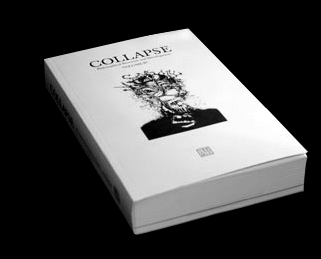
<p>At a time when the malady of book fetishism seems to have been cured finally (thanks to the modification of the publishing industry according to market sensibility), <b>Collapse</b> has endowed us with the frenzy of fetishism once again. From its cover that easily takes the fingerprint of its reader as a token of fetishistic intimacy to its hand-stamped number to its dimension to its meticulous typesetting and its publication logo, <b>Collapse</b> is saturated with subtleties which can only be spotted by a mind inflicted with fetishism. For readers, receiving <b>Collapse</b> is usually accompanied with the suspense of anticipation and thrill of the unpredictable. Even for the contributors, the arrival of <b>Collapse</b> comes with perspiration and heartbeat, as the contributor hastily flips through the pages to discover the hidden connections between the other contributions with his/her own. <br />
</p>]]>
<![CDATA[<p>After three volumes with diverse yet connected topics, the fourth volume <i>Concept-Horror</i> was published as a culmination of the previous volumes. Wars, famines, natural disasters and the inevitable fates of the body such as survival and death have given us this illusion that ‘thinking horror’ <b>[1]</b> is an undemanding task requiring no effort other than surrendering to sensation. Ironically nothing has been more disastrous for thinking horror than the overabundance of vacuous cruelties or absurd maladies; for it is relatively easy to mimic a battlefield, a bodily decomposition in a text, image or music. If horror is already everywhere, or in other words, if horror has already been culminated, thinking horror can easily turn into a case study, counting its countless manifestations. Yet it seems that with all the indulgence in horror via different mediums, humans have gained more self-estimation and adopted less hazardous courses for survival, immersed more within the illusion of a cosmos without horror. There is something profoundly wrong and terrible with humans (this might be indeed a compliment), for despite all these horrors, humans have proved that they are able to survive – at least as far as they themselves remember – with a parasitic tenacity and in complete indifference to cosmic horrors. It is as if humans have given a twist to the horror of the universe in a way that through their insistence on survival, economical openness and illusive intelligibility, they have become the very personification of cosmic horror and alienage.   </p>

<p>Doubtless, in regard to thinking horror, the present situation is highly discouraging. The nature of survival in all its forms includes a process of openness toward the outside which is predominantly bound to the affordability of the subject of survival in regard to its outside. Yet this outside to which the surviving subject opens itself up is merely an environment whose outsideness is inherently affordable for the principles of survival associated with that subject. Therefore, there is a mutual affordability between the surviving subject and the outside to which the subject opens itself up. The openness of the surviving subject to its outside is marked by its closure – that is the law of affordability associated with survival. The openness of humans toward horrors is inevitably an economical venture for mining that which is affordable. It is in this sense that for thinking horror, first, the so-called daring openness of humans toward the outside must be disenchanted, stripped from its fraudulent heroic role. Second, the affordable outside (the accessible human environment) must be disenchanted in regard to humans by being debunked through the positioning of the radical exteriority, the cosmic outside. Third, the simultaneous disenchantment of the surviving subject to the outside and vice versa must take place on the ground of pure indifference, or else horror is oedipalized, recycled as a fuel for survival and reduced to a matter of sensibility. The most extraordinary quality of <b>Collapse: Concept-Horror</b> is its speculative engagement with these three phases of thinking horror. Armed with a maligned rigor and an unprecedented verve for an all-embracing investigation of horror, <b>Collapse Volume IV</b> is a must for everyone not only obsessed with horror but also with philosophy, art and ethics. In a Lovecraftian sense, reading <b>Collapse</b> is like acquiring a trophy from <i>the Other Side</i>: </p>

<p><img alt="collapseiv-cover.gif" src="http://hyperstition.abstractdynamics.org/archives/collapseiv-cover.gif" width="321" height="259" border="0" /></p>

<p><b>George Sieg</b>'s <i>Infinite Regress into Self-Referential Horror</i>: Sieg’s essay at the beginning of Collapse IV has been poised to conduct a pre-emptive strike on the discourse of victimhood which has horribly distorted such concepts and domains like the other, the outside, us and them which are shared both by horror genre and socio-political discourses. Through presenting Houellebecq’s study of Lovecraft’s racism, Seig shows how Lovecraft’s fervor for Aryanism can be traced back to a more twisted and darker source: the emergence of the Zoroastrian germ-cell of monotheism which is pregnant with a strange xenophobia for which the inside and the outside have been displaced.  For a xenophobia whose loci of attention have turned inside out, not only racism but also a good willed openness leads to irresolvable problems and unforeseen consequences. Seig finds the true manifest of such inside-out racism (or conversely, openness toward the outside) in the concept of <i>Druj</i> which according to the Zoroastrians is the Mother of Abominations, an avatar of cosmic unlocalizability and the main protagonist of <i>Vendidad</i> (The Book of Anti-Demon Laws) – a true precursor for Lovecraftian fiction. The inside-out xenology of Sieg’s investigation also reads as an intriguingly aberrant re-examination of eso-tericism.  </p>

<p><b>Eugene Thacker</b>'s <i>Nine Disputations on Theology and Horror</i>: In his erudite essay, Thacker traces the genealogy of a certain strain of horror genre to theological discourses regarding resurrection and afterlife. The horror of the Slime, the Blob or that nameless Thing is the horror that leaks from the fissure or the gap between the living being (to live) and Life itself. It is from such a crack and sharp disjuncture between Life and the living being that the teratological legion of horror genre crawls in. The post-mortem afterlife of theology, Thacker shows, is a recoded form of this fissure which is a spawning zone for certain monstrosities – things which convey the horror of a life without the living being. At first sight, the horror of Thing might be the horror of a fiend without face, without form and without matter, but it is certainly not the only horror that it insinuates. The Thing exposes the externality of life to the living being. For the subject of survival, life itself is an exteriority, an impossible which can only be afforded and rendered possible at the cost of perishing in horror and a teratological holocaust in the realm of the living being. Life, therefore, becomes the very equal of Lovecraft’s cosmic alienage. Thacker’s essay is a startling biohorror odyssey into the depth of theology and its metaphysics. </p>

<p><b>China Miéville</b>’s <i>M.R.James and the Quantum Vampire</i>: In his ingenious contribution to Collapse: Concept-Horror, Miéville briefly exposes the fantastic and weird conceptual resources of his fictions which are entangled together in an utterly philosophic way. If this is just a fragment of the mechanisms, undercurrents and subterranean resources that Miéville nourishes his fiction with, then what is the rest? And how weird are they? More than anything, Miéville’s essay confirms that pulp is not only a host for the weird and horror but also for philosophical thought; and he himself as a ‘champion of pulp’ <b>[2]</b> is also a weird philosopher (and a philosopher of the weird), just as a horror writer who can be a god.<b>[3]</b> This strongly echoes Graham Harman’s bold defense of continental horror and science fiction to which we will return later. In <i>the Quantum Vampire</i>, Miéville performs an autopsy on the ultimate diagrammatic model of the weird+hauntology, the Skulltopus. Despite its concreteness, Skulltopus refuses to be literal, for it is the production of ‘haptic flirtation’ between two objects, a skull and cephalopodic tentacles, a quantum contact without the possibility of merger. Miéville’s haptic model, in this sense, can be a prototype for a weird metaphysics of objects. </p>

<p><b>James Trafford</b>’s <i>The Shadow of a Puppet-Dance</i>: In his massive treatise <i> Being No One: The Self-Model Theory of Subjectivity</i>, the German neurophilosopher Thomas Metzinger proposes that we are and have never been in direct and immediate epistemic contact with ourselves. Or simply, self is not but an illusion, ‘no one’s illusion’. Basing his essay on Metzinger’s theory, Trafford argues how the nemonymous horror of Ligotti’s fiction foresees the catastrophic consequences of Metzinger’s philosophy. Horror of Ligotti’s fiction, Trafford rightly suggests, is a horror dissipated by neither <i>us</i> nor <i>them</i> but ‘no one’, its source is the void and its mechanism is nemocentric (nemo-: no one). If self is merely the content of an ongoing and dynamic process i.e. the process of transparent self-modeling, then since childhood, ‘I’ have been a persistent illusion designed by the system as a functional module in order to regulate its interaction with the environment and facilitate the affording of the ‘outside’. And even further, this environment or affordable outside, is merely a fabricated scheme (a mirroring illusion) by which the system can represent itself in the environment and mirror it back to itself, and thereby, conjuring an alibi or illusive cognitive verification for the existence of its Self. Trafford incisively concludes that Ligotti’s fiction, in fact, takes its power as well as narrative formation from the ‘oneiric aphasia’ predestined by this ‘cognitive protectionism’ and ‘organic enslavement’ of the system. However, one question remains that neither Metzinger nor Ligotti have fully elucidated yet: exactly how this dynamic process of self-modeling has internally been generated over the course of evolution and how is this process correlated with the evolution of survival ex nihilo?<br />
  <br />
<b>Thomas Ligotti</b>'s <i>Thinking Horror</i>: A pillar for the venture that Collapse IV has embarked upon, Ligotti’s article is perhaps the coldest and fastest journey to the void. Illustrated by the portraits of dead monkeys, Ligotti’s text is an annotated post-mortem family photo-album dedicated to a bedtime story called human race. Ligotti’s first and foremost thesis, similar to Ray Brassier’s argument in <i>Nihil Unbound</i>, is that horror and thinking are the same thing. To think is to irrevocably plunge in horror and evaporate. The entire survivalist conspiracy of human race, Ligotti states, has been involved with devising schemes to dodge and temporarily escape the brutal consequences of enlightenment, an enlightenment which only emancipates on behalf of the void. For this reason, such enlightenment is comparable to the Cthulhu cult’s ‘holocaust of freedom’, where luminosity is inseparable from extinction. As Robin Mackay suggests in the introduction to Collapse IV, the first survivalist objection to Ligotti’s all-embracing pessimism is that writing itself and the laborious tasks involved in publication (even if all is done with no secret joy whatsoever) are distractions and in contradiction to such pessimism. I absolutely agree that writing on nihil or ranting about uncompromising pessimism ‘forces the reader to secrete something of the poison that is buried within them’, yet I am not fully convinced that this ‘invocation of demons’ through the act of writing is sufficient to tackle the survivalist or even a more pessimistic (albeit problematic) objection: this openness to bleak subjects through the act of writing cannot be entirely absolved from its survivalist impetus, for as we stated earlier, once openness is conceived as ‘being open to’ which in this case is ‘writing about will-to-extinction’, it operates as an implicit but devoted agent of survival. Openness for us – even if it is toward will-to-extinction – only amounts to survival because it is only a matter of our affordability; in other words, our openness is grounded on our survival and is regulated by what is at stake for the subject of survival rather than the target of openness. To this extent, the survivalist objection might indeed project a more fundamental pessimism, perhaps on the nature of pessimism itself. If all doors seem already closed, then we should <i>also</i> look into the nature of survival and see if it really brings with itself a purely survivalist and vitalistic impetus or something exterior to its ontological intention.<b>[4]</b>          </p>

<p><b>Quentin Meillassoux</b>’s <i>Spectral Dilemma</i>: Meillassoux has shown four times in Collapse that he is unquestionably among the most imaginative yet rigorous philosophers of today: first with his essay on time and hyper-chaos, second by his brilliant reconstruction of Deleuze’s text (which is among the best texts I have read on Deleuze), third with his reference to Captain Haddock in the Adventures of Tintin to explain the problem of correlationism, and finally for the forth time, by bringing his previous philosophic texts together in the form of an implicit ghost story with a Lovecraftian twist. Spectral Dilemma is set as an ethical development of the necessity of contingency. What are the consequences of rejecting the Principle of Sufficient Reason and instead embracing the absolute contingency of the laws of nature? Can the necessity of contingency be employed as an ethical resource, or more accurately, can the cosmic dread implicated by absolute contingency be reconciled with ethics, or even further, constitute its infinite resource so that ethics be posited in terms of the cosmic? Meillassoux examines these lines of inquiry by posing a new question: how can we bridge atheism and theism without submitting to either of them? Or is it possible to have a third type of engagement, a third mode of encounter with god and his dead corpse? His answer like his philosophy which shines forth from the most unexpected openings of thought is creatively novel. Meillassoux argues that this atheo-religious dilemma is essentially spectral, that is to say, it is a specter whose memory haunts us and requires a proper mourning in order for us to maintain an ethical rather than morbid living. If the question of the Divine is necessarily spectral because it has begotten by terrible deaths – either as victims of God’s extreme cruelty or God’s own death – then we must devise a space of mourning which can simultaneously conform to these two terrible deaths. Meillassoux then moves on and takes the thesis of <i>divine inexistence</i> through the law of absolute contingency or unbound chaos according to which despite the inexistence of the Divine, God may exist in future. Unfortunately, the end of the essay is too sudden, and leaves us with many questions as if it is a speculative prelude to further investigation and a massive thesis. But this should not dishearten any reader, for after all, when it comes to horror stories, one should anticipate the return of horror, the law of sinusoidal returns.</p>

<p><b>Benjamin Noys</b>’s <i>Horror Temporis</i>: Iain Grant in his work on Schelling remarks that as Time grows and expands, the role of things in it become progressively more insignificant. In his essay for Collapse IV, Noys claims that ‘the worst’ or ‘the most abominable’ in Lovecraft’s fiction is the yawning gap (<i>khaos</i>) of Time. It is not only because Time is saturated with vampiristic qualities in regard to things in it but also because Time is a blind god who does not even heed calls and cries of its own monsters and offspring. The unspeakable monstrosity of the Ones who threaten humanity is generated perhaps by a trauma induced by the pure indifference of Time to its offspring and natural laws. But since this trauma cannot be resolved by recourse to its origin as a result of itself being uprooted by the abyss of Time, it has no other way than being senselessly wrought upon others, or as in Lovecraft’s fiction, upon humanity. Noys rightly attributes to Time, a vortical structure which is repeated throughout Lovecraft’s stories as stygian gulfs, foaming gaps, black pits and rotting holes. Chaos of Time, Noys sinisterly elaborates, is in fact the blind genesis, a vortex from which the great Old Ones tumble upward and to which humanity is sucked in. This ascent and descent, however, are both the orphans of an absolute Time, begotten by its indifference to the necessity of natural laws.</p>

<p><b>Iain Hamilton Grant</b>’s <i>Being and Slime</i>: Iain Grant’s essay is my most favorite of all; refined, fresh, deft and beyond everything, it oozes a scholarly philosophy without any constraint. The title of Grant’s essay insinuates a deviation from Heidegger's Being and Time, but even more cleverly, an alternative retrospection for Badiou’s Being and Event and his thesis (which is mathematics = ontology). Those who have read Grant’s work <i>On an Artificial Earth: Philosophies of Nature After Schelling</i> know that the section 3.3 of the book, Organics as Antiphysics: Fichte contra Oken, argues how the notorious <i>Naturphilosophen</i> Lorenz Oken, by drawing upon a ‘mathematics endowed with substance’, develops a system which can generate complex multiplicities which are not only formal (matheme-oriented) but also substantial (substance-infused matheme). Grant’s essay in Collapse is a full-fledged development of the aforementioned chapter. What happens when the substance is mobilized by mathematical ideas, or even more importantly, matheme is invested with substance? If substance invests matheme, then, its germinal ground overlaps and becomes one with the generative ground of mathematics, zero. For Oken, this substantial zero is Ur-Slime (a thesis which makes Grant’s essay a perfect choice for this issue on Concept-Horror). Oken’s philosophy is essentially constructed on polarity (+ -); polarity is the first force in the universe which enables slime to have the ability of differentiation or generative introspection. It is the introspection of zero or slime or realization according to polarity that brings about the possibility of numbers or the manifold of particulars. This strikes me as a Schellingian god, a pure contraction or no-thing. Only out of the horror of problematical intimacy with the void, this god unfolds and creates the contingency of nature or the <i>explicatio</i> of universe. The contingency of nature (the <i>explicatio</i>) is grounded on the necessity of <i>complicatio</i> or God-contraction. Yet the grounding of nature's <i>explicatio</i> (contingency) and the manifold of particulars on the necessity of <i>complicatio</i> is indeed an act of 'ungrounding', for the God as contraction is the problematical binding of the void in its intensive no-thingness. Against theo-tyranny in which the act of grounding (i.e. the grounding of nature on the consolidated body of god) is the stratification of universe as layers of an already sealed god, the grounding that Schelling expounds on is the very act of ungrounding: the founding of contingency of nature on the necessity of no-thing or generative zero. Only once zero comes to terms with its own no-thingness or basal horror, the explication of nature becomes possible and diversity of particulars comes into being. </p>

<p><b>Graham Harman</b>’s <i>On the Horror of Phenomenology: Lovecraft and Husserl</i>: Beginning with mounting a vehement attack against the insipid and unimaginative dimensions of today’s academic philosophy, Graham Harman offers us an adventurous alternative for cotemporary philosophy. With feisty prose that reminds us of restless travelers and adventurers of the last century, Harman lays out the foundations of his weird and speculative realism. The philosophic resources of weird realism are continental horror and science fiction. If Harman’s reading of Heidegger is rogue and heretical, it is because for him, the role of Hölderlin for Heidegger has been substituted with that of Lovecraft. In his essay, Harman exposes the pulpy and weird body of phenomenology by suggesting that the weird and objects, like <i>wyrd</i> sisters always come hand in hand. First, Harman sets Lovecraft’s stories free from a Kantian reading by showing that the elusive abominations of Lovecraft’s fiction are not noumenal but phenomenal, and even worse part of our world. In demonstrating the non-Kantian nature of these loathing monstrosities, Harman conducts a sabotage against a Kantian reading of Lovecraft rather than adhering to a purely anti-Kantian front: the phenomenal and secured land of the finite, the last front of experience and consciousness, has already been taken over by weird finite things or phenomenal abominations. However, these objects or phenomenal abominations exude an excess of properties, an inner inexhaustible infinity which refuses to be accessed. This is, in a twisted way, equal to the diagonalization of the Kantian healthy finite with the excessively phenomenal (in)finite, the inner infinite life of objects. This excessive or extra-phenomenal finite is a source of pure malignancy and inexhaustible foulness against which Kantian ocean, the noumenal, is a puerile redundancy. In the second phase, Harman shows how this excess (of properties) or ineffability of objects lies at the base of Husserl’s phenomenology. The effect of objects of Harman’s weird realism is both of vertigo and horror, akin to Tilford’s objects whose skins slough off in a vertigo of diabolic particles and aimless electrons which never settle.</p>

<p>Collapse Volume IV is also a visual pilgrimage of the underworld: from the materialist fairy-tale of <b>Rafani</b> to the cartoonism of Eye-care by <b>Jake and Dinos Chapman</b> to <b>Oleg Kulik</b>’s dead monkeys album to slime-vortices of <b>Todosch</b> to <b>Steven Shearer</b>’s impersonal horrographic poems to <b>Keith Tilford</b>’s weird objects and the infinite deformity of those things in the jars photographed by <b>Kristen Alvanson</b>, everything has been deployed throughout the book, in such a way, not to give a sense of distraction or relief but to highlight its fiendish qualities and make anomalous pacts with the texts. <b>Robin Mackay</b> and <b>Damian Veal</b> have curated and refined a book which is a <i>tour de horreur</i>. </p>

<p><br />
<b>[1]</b> Also the title of Thomas Ligotti’s contribution to Collapse IV.</p>

<p><b>[2]</b> From R. Mackay’s introduction, p. 9. </p>

<p><b>[3]</b> In John Carpenter’s <i>In the Mouth of Madness</i>, after bringing the Old Ones (Them) to our world, the pulp-horror writer Sutter Cane reappears to the insurance detective John Trent and says: 'I am god now'. Trent (Sam Neill) opposes by saying: 'God cannot be a hack horror writer'.</p>

<p><b>[4]</b> For more details on survival as the implicit enforcer of the void see: The Corpse Bride: Thinking with Nigredo, Collapse vol. iv, Concept-Horror. </p>]]>
</content>
</entry>
<entry>
<title>Live Concept-Horror Party</title>
<link rel="alternate" type="text/html" href="http://hyperstition.abstractdynamics.org/archives/010404.html" />
<modified>2008-06-03T05:40:37Z</modified>
<issued>2008-06-03T05:40:37Z</issued>
<id>tag:hyperstition.abstractdynamics.org,2008://23.10404</id>
<created>2008-06-03T05:40:37Z</created>
<summary type="text/plain"> For those who happen to be in London on Saturday 7th June ... (address and more details)...</summary>
<author>
<name>R. Negarestani</name>
<url>http://www.cold-me.net</url>
<email>negarestani@cold-me.net</email>
</author>

<content type="text/html" mode="escaped" xml:lang="en" xml:base="http://hyperstition.abstractdynamics.org/">
<![CDATA[<p><img alt="event-small.gif" src="http://hyperstition.abstractdynamics.org/archives/event-small.gif" width="200" height="283" border="0" /></p>

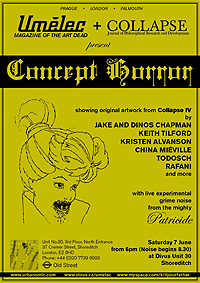
<p>For those who happen to be in London on Saturday 7th June ... (<a href="http://blog.urbanomic.com/urbanomic/archives/2008/05/party_at_last.html">address and more details</a>)</p>]]>

</content>
</entry>
<entry>
<title>The Horror of Something: commentaries on the littered universe and the weird</title>
<link rel="alternate" type="text/html" href="http://hyperstition.abstractdynamics.org/archives/010403.html" />
<modified>2008-06-03T03:41:19Z</modified>
<issued>2008-06-03T03:41:19Z</issued>
<id>tag:hyperstition.abstractdynamics.org,2008://23.10403</id>
<created>2008-06-03T03:41:19Z</created>
<summary type="text/plain">x-post eliminative culinarism This is a revised version of the paper I wrote for the Weird symposium at Goldsmiths (December, 2007); the paper was included in the pamphlet Benjamin Noys compiled for the event. Like my contribution for Collapse: Concept-Horror,...</summary>
<author>
<name>R. Negarestani</name>
<url>http://www.cold-me.net</url>
<email>negarestani@cold-me.net</email>
</author>

<content type="text/html" mode="escaped" xml:lang="en" xml:base="http://hyperstition.abstractdynamics.org/">
<![CDATA[<p>x-post eliminative culinarism</p>

<p><img alt="nigredo.jpg" src="http://blog.urbanomic.com/cyclon/archives/nigredo.jpg" width="450" height="307" /></p>

<p>This is a revised version of the paper I wrote for the Weird symposium at Goldsmiths (December, 2007); the paper was included in the pamphlet Benjamin Noys compiled for the event. Like my contribution for <i><a href="http://blog.urbanomic.com/urbanomic/archives/2008/05/collapse_iv_con.html">Collapse: Concept-Horror</a></i>, it deals with the logic of subtraction and ontology, but here the focus shifts from ‘vitalism and decay’ to the inherent inaccessibility and consequently unintelligibility of objects. The subtractive logic of ontology dictates a universal destiny for objects which becomes the source of ‘weirdness’ for the universe. Ontology in the light of the logic of subtraction renders objects irrevocably weird in that objects perpetually evade us and recede to utter unintelligibility. Robin Mackay hinted at this in the introduction to Collapse iv by drawing a comparison between my work and that of Graham Harman.</p>

<p><center>*  *  *</center></p>

<p>The weird is the destiny of all objects; it bespeaks of the fate of objects in that by conforming to their ontological constitution or immanent intension, objects relay and enforce the intention of that which is radically exterior to them. The weird is universal destiny as twist.  </p>

<p>The question of the weird cannot be <i>immediately</i> subsumed under the question of sense or experience; accordingly, it cannot be captured by statements and phrases such as ‘I think this is weird’, ‘feeling weird’, ‘I love weird things’, etc. The weird is not a matter of experience and sensation, for if it were then it would be a mere by-product of the relation of temporality and synchronicity to sense and the conditional; and hence reducible to a status of the monstrous or grotesque whose complete domestication has been <i>afforded from the outset</i>. Now, if the weird is primarily perpetuated exterior to sense and regardless of our access, then, is <i>being inaccessible</i> sufficient for being weird? Is the resistance to sense and experience, or in other words, diachronic disjunction with the synchronicity inherent to the transcendental enough to insinuate the weird? In being – in contrast to temporality – abysmally inaccessible, the object X does indeed confound whatever transcendental apparatus (consciousness, mystical intuition, sense, experience) has been designated to access it. In this case, the weird emerges out of the incompatibility between the futile attempts at access and the immanent inaccessibility or disjunctive resistance of the object X. By attempting to latch on to the inaccessible, the subject of access only becomes allergic to its own existence and the ultimate transcendental task imparted to it. It is in making sense out of X, that sense or consciousness becomes a <i>dead weight</i>, a corpse-like burden pressing on its own chest. Yet if weirdness relies upon the incommensurability between the inaccessibility or the refractory realm of the object and the subject of access, then the weird is indexed by the fatigue of sense, or in other words, it merely articulates a trauma. This incompatibility between inaccessibility of X and the subject or the apparatus of access is inexorable and so is the trauma. However, even if this trauma cannot be undone under any condition – and hence is unconditional and independent of any relation other than the inexistence of the relation as such (i.e. radical incommensurability) – it still <i>feeds upon</i> the subject of the access or sense.</p>]]>
<![CDATA[<p>Whether as the image or the subtle register of this incommensurability, the weird only endures as long as sense – involuntarily or not – insists upon its intelligibility, or as long as the subject of access maintains its existence. Once sense separates from its presumed intelligibility, or the subject of access fully deteriorates, then the weird withdraws. Such seizure of intelligibility or determination of access does not need to happen on the basic or elementary material level, for as Houellebecq (<i>The Elementary Particles</i>), Juan Rulfo (<i>Pedro Paramo</i>) and Lovecraft (<i>Cthulhu mythos</i>) have envisioned, the inaccessible, already dead or aimless objects, particles and stars can haunt the space without any correlation, influence, relation, warmth of collectivity, individuation or any consolidating narrative whatsoever. Dead things can indeed roam in the tenebrous vastness of the universe or even lurch on chthonic superficialities of the earth long after the destruction of intelligibility, sense or the subject of access. Yet as Lovecraft insinuates, this vacuous horror does not obstruct the weird; it reinforces it. Even if all apparatuses of access are eradicated and all manifests of intelligibility cease to exist, the weird persists. <i>As long as something (anything) endures and remains by, for or within itself, the weird is perpetuated autonomously and without any objective</i>. This brings us to three speculations: </p>

<blockquote>The blind cosmos grinds aimlessly on from nothing to something and from something back to nothing again, neither heeding nor knowing the wishes or existence of the minds that flicker for a second now and then in the darkness. (<i>The Silver Key</i>)</blockquote>

<p><b>The conjecture of the littered universe</b>: The weird diagrammed by Lovecraft is that of a universe which, even though it has been denuded to its bare and unresponsive objects, cannot help but be weird. The universe is – non-metaphorically – a heap of rubbish and garbage whose objects merely remain amid their own detritus and waste, in unintelligible promiscuity with each other. The objects exude weirdness just by remaining so and as such and without any affinity or common border whatsoever with anything outside – that is, they roam aimlessly and litter the universe. If just by remaining so and as such (viz. being something, anything), independent of any correlation or affinity, the weird ensues, then weirdness is immanent to the destiny of all objects, the fate of being <i>something</i>. Given that the weird emanates even when the object is sealed from the outside, then what is this destiny that not only includes all objects but also guarantees the perpetuation of the weird? Such all-inclusive destiny, first and foremost, should be irrespective of the object’s properties, attributes and belongings. For this reason this destiny should be posited under the rubric of <i>subtraction</i> which presupposes the shedding of belongings or points of access in order to bring the possibility of remaining in itself or being something. Remaining-in-itself (being aimless) is only possible by the removal of all properties (<i>aphaeresis</i>) and the mobilization of non-belonging (subtraction). To this extent, the destiny (<i>werde</i>) that simultaneously amounts to or develops into the refractory closure of the objects and their autonomous weirdness is the fate of all objects, the primary and basic prerequisite of being something – that is <i>remaining so and as such</i>. Yet to speak of <i>to remain so and as such</i> is not possible without taking into account the priority and the primacy of subtraction. If, as Lovecraft emphasizes, the weird endures long after the demise of the subject of access, in its own unrecognizable enclosure, then the source of this weirdness has something to do with remaining of the object as such, or more accurately, with remaining as an object or remaining as something. <i>To remain</i> (i.e. the object’s remaining so and as such), however, both implicitly and explicitly suggests subtraction. <i>Explicitly</i>, because an object cannot remain in itself, or more accurately, cannot withdraw from correlation, unless all its belonging and properties by which access or correlation is anticipated are taken away, removed and subtracted. What can be explicated or developed from the object is that which should be subtracted so that the object can remain in itself, uncorrelated and weird. <i>Implicitly</i>, because in order to embody itself as <i>something</i> against the annihilative vector of subtraction (nothing) that removes all properties, the remaining must and is only able to perpetuate itself in <i>remaining less</i>. Therefore, in an ontological twist, in order to remain in themselves, the objects of this littered universe have to presume an internal vector of subtraction by which inaccessibility and non-correlatability (<i>viz</i>. remaining so and as such) is only possible by remaining less. This is the intensive or implicit vector of subtraction which overlaps with the possibility of remaining in itself and is posited as its ontological guarantor.</p>

<p>The intensive vector of subtraction or <i>remaining less</i> – inherent to the aimless or blind universe perforated by objects which resist correlation – attests to the radical subversion embedded in the destiny of all objects. This radical subversion or the source of weirdness can be grasped in terms of ontological intension / intention (the destiny of objects) and the perforation of such intension (subversion of that destiny): The weird or littered universe can only effectuate itself once the object roams aimlessly. This aimless or unresponsive object bespeaks of objects in themselves and is uncorrelatable. Yet, in turn, the weird as autonomous senselessness or resistance to correlation attests to the irreducible destiny of all objects; that they can only be enclosed in themselves <i>by remaining so and as such</i>. But why do we call the intensive idea of ontology that is remaining so and as such, destiny (<i>wyrd</i>)? Because <i>remaining so and as such</i> as the universal destiny of objects and the source of weirdness not only guarantees the inaccessibility of objects (hence making the universe littered with unintelligibility) but also obliges the objects to <i>remain</i> in order to be in themselves and evade access. In other words, the intensive idea of ontology dictates that in order for objects to remain in themselves and defy access, they need to shed their belongings. For objects, the continuation of their survival (as an unintelligible) is only possible by employing the vector of subtraction as an ontological guarantor. <i>To remain</i> is to affirm the possibility of surviving subtraction, whose annihilative power is effectuated by the removal of all belongings and properties, and hence the mobilization of non-belonging or Nothing. For this reason, remaining <i>per se</i> compels the object to be <i>something</i> – as that which remains after subtraction – in order to be in itself and remain non-correlated, namely, unintelligible. The universal destiny of objects entails that in order for the object to litter the world with their unintelligibility or inaccessibility and render the universe weird, they must first be <i>something</i> and mobilize the ontological vector of remaining.  </p>

<blockquote>... the ripples that told of the writhing of worms beneath. (<i>What the moon brings</i>)</blockquote>

<p><b>The conjecture of problematic intension / intention</b>: <i>Prima facie</i>, this <i>being something</i> of the non-correlated object signals the triumph of vitalism over nothing through a subtle trickery – short-circuiting Nothing by becoming nothing outside.<b>[1]</b> However, something, too, can only be something if it remains. To remain and to be something are immanently inseparable. This is where <i>to be something</i> or <i>to remain</i> as the destiny of the object in itself and the guarantee of a littered aimless universe is subverted from within. For remaining at any instance is not possible until the two vectors of Nothing from within and from without are unconditionally affirmed and complied with: (1) the mobilization of non-belonging by which attributes, properties, belongings and nodes of correlation are removed and subtracted (2) the interiorization of Nothing whereby remaining and its perpetuation (remaining in itself) is not possible other than in remaining less or intensive diminution. By approximating the interiorized Nothing, the remaining can continue to remain less, or in other words, remain in itself. </p>

<p>It is through <i>remaining in themselves</i> (or remaining so and as such) that objects can break apart from the correlation or the subject of access and withdraw to their unintelligible enclosure, rendering the universe irrevocably weird: particles, objects and stars roaming aimlessly in an stygian emptiness. It is the weirdness of ‘something’ as an ontological tenacity or a survivalist insistence on remaining that ultimately points to the horror of something: <i>in order to be something, there is no other way than remaining for and within itself, or more accurately, sinking into unintelligibility</i>. The point of being is being unintelligible since remaining as the ontological medium of something is not possible unless belongings and attributes through which access is made possible are shed. To put it differently, if <i>something</i> has to employ remaining as its ontological medium, it must also exteriorize extraneous belongings in order to remain in itself; this is necessitated by the logic of subtraction. Being something is equal to withdrawal from belongings or points of access by which the object can be correlated to its outside and rendered intelligible. More accurately, remaining in being is subtractively correlated to the shedding of belongings. Unintelligibility of objects is immanent to this subtractive correlation. The subtractive logic of ontology requires that objects offer an uncompromising resistance toward access and <i>being</i> is put to the test by its perpetual evasion of intelligibility. For this reason, although it is ontology that renders objects unintelligible, it is the weird that takes the ontological destiny of objects to its cosmic level: to litter the universe with unintelligibility is the very point of ontology. The intimacy of the weird with nihilism is not a straightforward one; it is not a token of mere absurdity of the universe, it is a bond as twist. The entire panorama of the weird infers a twisted intimacy between something and nothing. </p>

<p>Something can endure in nothing only through yielding to the unintelligibility which is entailed by remaining in itself, hence withdrawal from any potential node of correlation or subject of access. Survival is not possible other than by becoming obstinately unintelligible. Therefore, <i>remaining so and as such</i>, with its implicit vitalistic ethos, is the destiny of all objects but at the same time it is also the veneration of unintelligibility on all levels. Vitalism can only bolster the idea of ontology by sundering the correlation of ontology with any ideal whatsoever, be it sense, intelligibility or <i>the Ones already there</i>. This is enough to render the universe littered with objects weird but it is not weird enough; for even the aimless objects in and by themselves are weird because their destiny to be something cannot be established except by the emphatic intervention of Nothing from the inside. To resist correlation – perpetuating itself through subtraction or shedding attributes, properties and belongings – the object must withdraw and remain to and in itself. To remain or survive subtraction is the destiny of all objects but to remain in itself (required for rendering correlation obsolete) is indeed equal to persistence in remaining and insistence on survival. For this reason the weird, as a universe cluttered with enclosed and uncorrelatable objects which only contribute to unintelligibility, is tethered to a seemingly vitalistic intension inherent to remaining <i>per se</i>: remaining by and within itself separated from all that is extraneous (<i>reliquum esse</i>) is impossible other than by persistence in remaining (<i>superesse</i>) i.e. by surviving subtraction. To put it differently, in order to remain in itself and thus resist correlation and contribute to the weirdness immanent to the littered universe, the object has to position itself in respect to subtraction. Only by eventuating itself through subtraction, can the object remain within in itself, separated from all that is extraneous i.e. nodes of correlation and points of access. Only by being subtractively correlated to its belongings, can the object defy access. This extension of the object to nothing constitutes the explicit vector of subtraction as previously elaborated. Subtraction is necessary in order to resist correlation, hence contributing to the unintelligibility of the littered universe or emanating the weird. However, once subjected to subtraction, the object cannot remain enclosed within itself other than by continuing to remain – that is, in insisting upon survival. This ‘continuation in remaining’ or ‘insistence on survival’ is the inevitable ontological intention / intension inherent to the object for emanating the weird by resisting correlation and access. In short, ‘persistence in remaining’ or ‘continuing to remain’ is the ontological intension of ‘remaining by and within itself’ which is the guarantee of uncorrelatablity. To this extent, the weird adds a strong survivalist or immanently ontological dimension to objects. </p>

<p>However, this ontological intention – explicable in terms of persistence in remaining or survival – cannot establish itself other than by submitting to the intention of that which is radically exterior to it. Surviving subtraction or remaining is only possible by interiorizing another vector of subtraction or Nothing whereby <i>to continue to remain</i> (survive) is equal <i>to remaining less</i> (i.e. approximating Nothing).<b>[2]</b> Thus in a weird twist, as the ontological intension inherent to ‘the object remaining within itself’, survival or ‘persistence in remaining’ cannot maintain itself unless it unconditionally conforms to the intention of Nothing. In other words, the object emanates the weird by remaining in itself, that is to say, persists in remaining under the explicit vector of subtraction; but by doing so, it becomes the puppet of that which is radically exterior to its intention i.e. Nothing. Thus the weird is propagated from within and without the object, in a chain of unintelligible puppetry in which no intention and hence no puppet or puppeteer can be established unless by channeling the intension of nothing. To this extent, the weird is not the cancellation of puppetry in its explicit hierarchy and implicit chaos, for puppetry in all its forms is the cosmic consequence of nothing in acting upon itself in order to bring about the possibility of something, and in the survival of something which channels the intention of nothing. Puppetry is the realization of the ethics of the weird: in conformity to my intention, I enforce the radically exterior intention of nothing.   </p>

<p>In conformity to its own intension, something can only be something if it simultaneously prioritizes and interiorizes the intention of Nothing – that is, the implicit vector of subtraction. The basic intention of <i>something</i> is remaining in itself. Yet remaining as the ontological intention of something is always remaining less as the result of its subtractive correlation with belongings. Remaining less, that is to say, remaining <i>per se</i> cannot be guaranteed and maintained unless the priority of nothing is affirmed. Because the continuity of remaining which is eventuated as lessening or diminution can only perpetuate and rectify itself according to nothing or an exterior zero – that is Nothing as that to which nothing can belong or as the indubitable limit of lessening. ‘Something in itself’ litters the empty blackness with objects which are <i>something qua unintelligibility</i> and thereby emanates the weird as a cosmic reality. Yet <i>nothing</i>, seeping through the intension of something, renders the weird – intrinsically and necessarily – problematic. For this reason, radicality of the weird is manifested in its problematic intension: <i>something</i> can only litter the emptiness without succumbing to correlation and intelligibility – that is, the weird can only be emanated by <i>some thing</i>, if that thing remains by and within itself. Only through an utter compliance to <i>nothing</i> – both implicitly and explicitly – can something remain in itself, or more accurately, remain less. The remainder at any instance must correspond to another vector of subtraction whose direction coincides with the direction of remaining. Here the weird as the destiny of all objects falls back upon another destiny (<i>werde</i>) – the problematic intension. </p>

<p>By remaining in itself, enclosed from nodes of access or abiding to its own intention, the littering object emanates the weird. Yet this intension cannot be established other than by approximating nothing or interiorizing the vector of subtraction whereby ‘remaining in itself’ (as the intention of something) is ‘remaining less’ (the intention of nothing). Therefore, the intention (<i>intension</i>) of the weird becomes entirely problematic by channeling the intension of <i>nothing</i>. Once again, the radicality of the weird is guaranteed by the sheer problematic-ness of the intention inherent to its source of emanation – the aimless, enclosed, inaccessible object. Ultimately, the weird feeds on the power of the insolubly problematic. The persisting vitalist destiny of the weird is undermined by the intervention of nothing that is required for such a destiny to establish itself. Correspondingly, the weird is delivered to the problematic that perforates <i>something</i> on behalf of <i>nothing</i> as well as establishing something to convey nothing. The ontological intension of <i>something</i> is alive and vigorous only in so far as it animates the problematic that bores through it. Neither the weird nor the destiny of all objects can be invested outside the radically problematic. It is in fact the weird that is nourished by this problematic-ness; exposing the twist between the ontological intention and the intention of nothing (as radical exteriority) to its fullest extent. </p>

<p>To this extent, the weird can be addressed as two overlapping destinies, counted as two weirds: </p>

<p>1. The weird emanated by the littered universe: uncorrelatable and inaccessible objects cluttering the emptiness so aimlessly that they cannot be recognized as anything other than holes, bugs and shifting porosities in the blackness of the universe. This is the weird entailed by the objects remaining in themselves; acceding to a causality whereby the withdrawal of objects to themselves exudes the weird. Through this weirdness necessitated by such causation, everything inconsistently happens for whatever reason and nothing can consistently ever happen. For, breaking apart from the correlation and resisting access – hence constituting such causality – objects must remain by, for and within themselves. Once every object remains in itself or withdraws to <i>something qua and as unintelligibility</i>, then the universe and whatever happens in it (or even if nothing ever happens in it) is rendered weird. This is the weird connected to the destiny of objects (weird as <i>werde</i>). According to this weird, <i>ex nihilo</i> infers the vacuity of ontology in an absurd competition with the superficial nothingness of the universe.</p>

<p>2. The weird of the pre-emptive problematic: in order to conform to their destiny and basic requisition, and in order to render the correlation obsolete or to be radically unsympathetic toward access, objects must withdraw to and remain in themselves. Even if ‘the object remaining within itself’ is effectuated as nothing outside, it indeed denotes surviving a subtraction whereby nodes of access and correlation are removed and taken away (extension to nothing). However, this survival from the subtracting vector is only attainable by interiorizing another vector of subtraction. This means that in order to withdraw to and remain in itself, the object must abide by its ontological intension which is <i>remaining so and as such</i>. We already noted that on the one hand, <i>remaining so and as such</i> corresponds to the continuation of <i>subtraction</i> as what guarantees the cancelation of all nodes of correlation or access. On the other hand, <i>remaining so and as such</i> as the ontological intension of <i>something</i> cannot invest itself outside of <i>remaining less</i> or <i>intensive diminution</i>. In short, remaining is always remaining less. The remainder cannot continue to remain in itself unless it approximates <i>nothing</i> by which it can remain less, thus reinforcing the subtraction. For this reason, the ontological intention of objects in themselves cannot be enacted other than by the emphatic intervention of Nothing. This is another way to say that by abiding to their intention for remaining in themselves, the objects are puppetized by the intention of <i>nothing</i>. Nothing vermicularly looms out of the intended and makes it problematic. The universe is infinitely weirder when we know, that even the gimmick of <i>ex nihilo</i> is the perforation of something with nothing, not the other way around.</p>

<p>In this regard, the second weird is the subversion of the destiny of all objects: in abiding by their own inaccessible fate that is remaining so and as such, the objects bring about the intervention of nothing – that is, the destiny necessitated by radical exteriority. The weird as the destiny of objects displays its problematic constitution and thereby bolsters its irreconcilable disjunction with the grotesque, fantastic or even uncanny. The second weird is the weird as the porous, the perforation caused by the worms which squirm and thus enforce the logic of the void within something. The perforation, the weirdness, depends less on the resistance of something than the wiggling of the worms. Or more precisely, the problematic intention is more on the side of the inevitable intrusion of nothing rather than the resistance of something. <br />
   <br />
<b>The conjecture of the horror that cannot be culminated</b>: If the weird is the destiny of objects and objects only need to remain by and within themselves to emanate the weird, then what genre of horror can effectively channel the weird? By genre, we mean the causalities or the ways – transcendental or immanent – through which horror unfolds itself or is unfolded. In this sense, we can temporarily ignore the definition of horror. Regardless of the medium (fiction, cinema, videogames, ...), there are four <i>modi operandi</i> whereby the horror is exposed or imposed. These four alternatives – albeit reductively and fuzzily connected to each other – can be enumerated as follows:</p>

<p>(1) The apotheosis of revelation as related to an intelligible truth, that is to say, the exposition of the truth associated to an intelligible force or entity. We call this the horror of intelligibility: ‘Lord works in mysterious ways.’   </p>

<p>(2) The revelation of unintelligible nothing, or in other words, the blind void which will be exposed as the autophagic truth underlying everything. This is the horror of unintelligibility whose imposition is the exposition of the first one’s fatuity and annulment: Rabid Nihilism </p>

<p>(3) The impossibility of revelation or the impossibility of any truth at all – be it unintelligible void or intelligible something. Revelation in itself is indeterminable because neither the imposition of nothing nor the exposition of something can be determined – the horror of indeterminability (sequelism and video games)   </p>

<p>(4) The imposition or exposition of <i>something</i> (anything) – be it a truth or not, temporarily or abysmally – is only possible by the intervention of something radically exterior to it. Solely by abiding to its ontological intention (remaining so and as such), <i>something</i> passes on the intension of <i>nothing</i> in the form of the problematic. This is the horror that seeps through only <i>by remaining so and such</i>, because <i>to survive</i> or <i>to be</i> is <i>to remain problematic</i>. We call this the <i>horror of problematic intension</i> which, with utter subtlety, blurs the boundaries between the first, the second and the third horror genres.<br />
 <br />
As argued previously, the fourth genre or the horror of the problematic intension is the genre of horror that transmits the weird. In this genre, nothing needs to be exposed or imposed because that which endures or remains is by itself weird. The horror of problematic intension essentially cannot be brought to any culmination but it does not entail the interruption of the ongoing climax either. In this sense, the survival horror genre conveys such a horror associated with the weird: in the lexicon of the videogame, the horror is neither the anticipation of the ‘boss’ at the end of the game, nor of his absence; nor is it the supernatural, or the growing hordes of undead armies; nor the uncanny ambience; it is the very definition of survival that is pregnant with the problematic from the beginning.<b>[3]</b>    <br />
    </p>

<p><b>Endnote</b></p>

<p><b>[1]</b> This ontological circumvention can be explained in terms of subtraction / negation: Ontology evades nothing by utilizing it in the form of the negative which is required for the operation of subtraction; since subtraction, <i>at least explicitly</i>, is able to employ nothing as an ontological resource in that subtraction is the mobilization of the negative along two vectors in order to simultaneously implicate both the removal of belongings and conservation of a remainder. The extensive vector of subtraction negates or takes away belongings to bring about the possibility of preservation and conservation i.e. remaining. This way subtraction customizes nothing as an opportunity by which the intensive idea of ontology (<i>viz</i>. remaining as such) can be correlated with the inevitable shedding of belongings or mobilization of nothing.       </p>

<p><b>[2]</b> To provide a further clarification on how the continuation of the remaining or remaining in itself is only possible in remaining less – subtractive extension and diminutive intention – subtraction can be mathematically albeit schematically demonstrated. Assuming there are two geometrical magnitudes of <i>A</i> and <i>B</i> where <i>A</i> > <i>B</i> as the ideal ground of the procedure and a guarantee for its continuation (iterative subtraction). The procedure starts by subtracting the greatest multiple of the smaller magnitude <i>B</i> (henceforth <i>m</i><i>B</i>) from the greater multiples of the greater magnitude <i>A</i>: <i>A</i> – <i>m</i><i>B</i> = <i>R</i>. The result of the subtraction as hitherto a conserved part is the remainder <i>R</i> which is less than the smaller magnitude <i>B</i> (<i>R</i> < <i>B</i>). Since the remainder <i>R</i> is less than the smaller magnitude <i>B</i>, the procedure is continued by subtracting the greatest multiple of the remainder <i>R</i> (henceforth <i>n</i><i>R</i>) from the smaller magnitude <i>B</i>: <i>B</i> – <i>n</i><i>R</i> =<i>r’</i>. The result of the subtraction is again a remainder but it is less than the previous remainder (<i>r’</i> < <i>R</i>). Therefore, persistence or continuation in remaining <i>viz</i>.<i> to remain</i> can only be perpetuated through <i>r</i>s smaller than <i>R</i>. Even if <i>r</i> does not become equal to zero, in order to remain less and continue to remain, it must conform to the priority of zero or no-thing as that which is <i>already there</i>.   </p>

<p><b>[3]</b> In the lexicon of the video game, the AI-based entity (the enemy) which the player has to defeat or be defeated by in order to progress in the game or finish the game is called boss. Therefore, boss in video games is usually equal to the points required for changing the level of the game or concluding it.</p>]]>
</content>
</entry>
<entry>
<title>Reinventing philosophy in horror [updated]</title>
<link rel="alternate" type="text/html" href="http://hyperstition.abstractdynamics.org/archives/010294.html" />
<modified>2008-04-27T10:47:28Z</modified>
<issued>2008-04-27T10:47:28Z</issued>
<id>tag:hyperstition.abstractdynamics.org,2008://23.10294</id>
<created>2008-04-27T10:47:28Z</created>
<summary type="text/plain"> Preview (Robin Mackay&apos;s introduction to this volume) Finally the promised issue of Collapse on concept-horror: We are delighted to announce that Collapse Volume IV will be published May 2008 and is now available for advance purchase online. Collapse IV...</summary>
<author>
<name>Hyperstition</name>


</author>

<content type="text/html" mode="escaped" xml:lang="en" xml:base="http://hyperstition.abstractdynamics.org/">
<![CDATA[<p><img alt="Collapse-Tilford.jpg" src="http://hyperstition.abstractdynamics.org/archives/Collapse-Tilford.jpg" width="350" height="522" border="0" /></p>

<p><a href="http://blog.urbanomic.com/urbanomic/archives/c4intro.pdf"><b>Preview (Robin Mackay's introduction to this volume)</b></a></p>

<p>Finally the promised issue of Collapse on concept-horror:</p>

<p>We are delighted to announce that <b>Collapse Volume IV</b>  will be published May 2008 and is now available for advance purchase online.<br />
<P><br />
<b>Collapse IV</b> features a series of investigations by philosophers, writers and artists into <b>Concept Horror</b>. Contributors address the existential, aesthetic, theological and political dimensions of horror, interrogate its peculiar affinity with philosophical thought, and uncover the horrors that may lie in wait for those who pursue rational thought beyond the bounds of the reasonable.</br><br />
<b>George Sieg</b>'s <i>Infinite Regress into Self-Referential Horror</i> demonstrates the simultaneously cognitive, existential and political nature of Horror, through a conceptual investigation of the primacy of victimhood for the affect of horror, tracing its origins to the Zoroastrian concept of <i>Druj</i>.</br><br />
In <i>The Shadow of a Puppet-Dance</i>, <b>James Trafford</b> tracks weird fiction writer Thomas Ligotti's anticipation of the radical thesis of neurophilosopher Thomas Metzinger's book Being No-One: namely, that 'nobody ever was or had a self'.</br><br />
In <b>Thomas Ligotti</b>'s own contribution to the volume, <i>Thinking Horror</i>, he takes up the work of obscure Norwegian philosopher Peter Zapffe, among others, to take an unflinching journey into the depths of pessimistic thought.</br><br />
As a counterpoint to Ligotti's deflation of human hubris, <b>Oleg Kulik</b>, the internationally-acclaimed Ukrainian contemporary artist known for his disturbing investigations into the borders between life and death, human and animal, contributes his photographic series <i>Memento Mori: Dead Monkeys</i>.</br><br />
<b>Eugene Thacker</b>'s <i>Nine Disputations on Theology and Horror</i> gives a detailed and penetrating account of the 'teratological noosphere', discussing the way in which a certain horror has perenially accompanied the concept of 'life', from Aristotle to Lovecraft.</br><br />
Novelist <b>Michel Houellebecq</b> is well-known for his evocation of the horror that dwells within the banalities of contemporary life. His poems, of which a selection are translated into English here for the first time, distil his powerful vision into translucid moments of dread.</br><br />
<b>Jake and Dinos Chapman</b>, the notorious Brothers Grim of the British artworld contribute a set of drawings created exclusively for Collapse. The cartoon-horror of <i>I Can See</i> continues their investigations into the connection between laughter and horror through the programmatic impoverishment of the aesthetic.</br><br />
In the third of a 'trilogy' of essays published in <b>Collapse</b>, <i>Spectral Dilemma</i>, Quentin Meillassoux reveals some of the ethical consequences of his deduction of the 'necessity of contingency', through an examination of the problem of 'infinite mourning' for the dead.</br><br />
<b>Kristen Alvanson</b>'s photographs, at once repellent and fascinating, of preserved specimens of deformed and mutated animals and humans, are accompanied by a text which discusses Par&eacute;'s sixteenth-century treatise which makes of taxonomy itself something monstrous, as demonstrated in Alvanson's diagrammatic presentation of the <i>Arbor Deformia</i>.</br><br />
German artist <b>Todosch</b>'s meticulous drawings seem to depict varieties of heterogenous slime in the process either of disintegration or coagulation, making them a perfect companion to <b>Iain Hamilton Grant</b>'s <i>Being and Slime</i>. This untimely excavation of nineteenth-century naturephilosopher Lorenz Oken - according to whom the generation of the universe from a 'primal zero' corresponds to its coagulation from a 'primaeval mucus' - puts an entirely new slant on Badiou's notion of 'founding on the void'.</br><br />
<b>Benjamin Noys</b> meditates on Lovecraft and the real, revealing that the most abyssal of Horrors is <i>Horror Temporis</i>.</br><br />
In <i>The Corpse Bride:Thinking with Nigredo</i>, <b>Reza Negarestani</b> shows how Aristotle and Plotinus both unlock and dissimulate the ontological mechanism expressed by an unspeakable form of Etruscan torture.</br><br />
Canadian artist <b>Steven Shearer</b> contributes a new series of his <i>Poems</i> - striking graphical pieces created through a manipulation of the nihilistic and extreme titles and lyrics of death-metal bands.</br><br />
<b>China Mi&eacute;ville</b>, better known for his bestselling weird fiction novels, writes on <i>M.R.James and the Quantum Vampire</i>, interrogating the dyad of the weird and the hauntological, and introducing us to a new fearsome creature from his arsenal ... behold the Skulltopus!</br><br />
Czech art collective <b>Rafani</b> present their cycle <i>Czech Forest</i>, an adaptation of folk-tale imagery which presents a very modern tale of warcrime and revenge from the end of WWII.</br><br />
<b>Graham Harman</b> returns to <b>Collapse</b> with <i>On the Horror of Phenomenology: Lovecraft and Husserl</i>. In a polemical defence of 'weird realism', Harman demonstrates that philosophical thought has more in common with weird and horror fiction than it might like to admit.</br> <br />
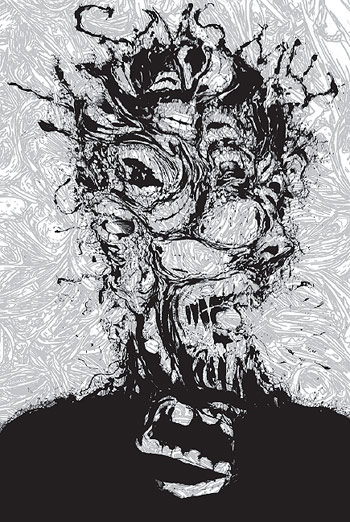
<i>Singular Agitations and a Common Vertigo</i>, <b>Keith Tilford</b>'s series of images, deftly disintegrated objects with more than a hint of 'pulp', anticipate and shadow Harman's invocation of the weird inner life of objects.</br><br />
Collapse Volume IV // Ed. R. Mackay // May 2008 // 390pp // Limited Edition 1000 copies // ISBN 978-0-9553087-3-4 // &pound;9.99 </br><br />
<a href="http://blog.urbanomic.com/urbanomic/archives/2008/04/collapse_volume.html">More details Here.</a><br />
<a href="http://blog.urbanomic.com/urbanomic/archives/2008/04/collapse_iv_ava.html">Pre-order Here.</a></p>]]>

</content>
</entry>
<entry>
<title>Urbanatomy</title>
<link rel="alternate" type="text/html" href="http://hyperstition.abstractdynamics.org/archives/010165.html" />
<modified>2008-02-26T01:41:47Z</modified>
<issued>2008-02-26T01:41:47Z</issued>
<id>tag:hyperstition.abstractdynamics.org,2008://23.10165</id>
<created>2008-02-26T01:41:47Z</created>
<summary type="text/plain"> This is my excuse ... but there&apos;s some numbo jumbo in the pipeline Prosperous Year of the Rat everybody....</summary>
<author>
<name>Old Nick</name>

<email>ccru00@hotmail.com</email>
</author>

<content type="text/html" mode="escaped" xml:lang="en" xml:base="http://hyperstition.abstractdynamics.org/">
<![CDATA[<p><img alt="guidebook_full.jpg" src="http://hyperstition.abstractdynamics.org/archives/guidebook_full.jpg" width="890" height="593" border="0" /></p>

<p>This is my excuse ... but there's some numbo jumbo in the pipeline</p>

<p>Prosperous Year of the Rat everybody.<br />
</p>]]>
<![CDATA[<p>PS. Amazon link for anybody feeling extravagant:<br />
http://www.amazon.com/Urbanatomy-Shanghai-2008-Guides/dp/7508511735/ref=pd_bbs_sr_1?ie=UTF8&s=books&qid=1203990034&sr=8-1</p>]]>
</content>
</entry>
<entry>
<title>Its spine is growing</title>
<link rel="alternate" type="text/html" href="http://hyperstition.abstractdynamics.org/archives/009853.html" />
<modified>2007-11-05T06:58:38Z</modified>
<issued>2007-11-05T06:58:38Z</issued>
<id>tag:hyperstition.abstractdynamics.org,2007://23.9853</id>
<created>2007-11-05T06:58:38Z</created>
<summary type="text/plain"> Collapse Volume III: &apos;Unknown Deleuze&apos; is now available. Update: Introduction to vol. III...</summary>
<author>
<name>Hyperstition</name>


</author>

<content type="text/html" mode="escaped" xml:lang="en" xml:base="http://hyperstition.abstractdynamics.org/">
<![CDATA[<p><img alt="Collapse III" src="http://hyperstition.abstractdynamics.org/archives/collapse3.jpg" width="300" height="217" border="0" /></p>

<p>Collapse Volume III: 'Unknown Deleuze' is  now <a href="http://blog.urbanomic.com/urbanomic/archives/2007/08/buysubscribe.html">available</a>. </p>

<p>Update: <a href="http://blog.urbanomic.com/urbanomic/archives/Collapse3Intro.pdf">Introduction to vol. III</a></p>]]>

</content>
</entry>
<entry>
<title>Necropolis of world politics: Middle East and politics of plot holes (part I)</title>
<link rel="alternate" type="text/html" href="http://hyperstition.abstractdynamics.org/archives/009840.html" />
<modified>2007-10-31T07:52:33Z</modified>
<issued>2007-10-31T07:52:33Z</issued>
<id>tag:hyperstition.abstractdynamics.org,2007://23.9840</id>
<created>2007-10-31T07:52:33Z</created>
<summary type="text/plain">This essay will be posted in three installments. The visuals (following in the next installments) and the ideas have been developed in collaboration with the artist Kristen Alvanson. If contemporary world politics inconsistently defies both holistic reading methodologies and their...</summary>
<author>
<name>R. Negarestani</name>
<url>http://www.cold-me.net</url>
<email>negarestani@cold-me.net</email>
</author>

<content type="text/html" mode="escaped" xml:lang="en" xml:base="http://hyperstition.abstractdynamics.org/">
<![CDATA[<p>This essay will be posted in three installments. The visuals (following in the next installments) and the ideas have been developed in collaboration with the artist <a href="http://www.kristenalvanson.com/">Kristen Alvanson</a>. </p>

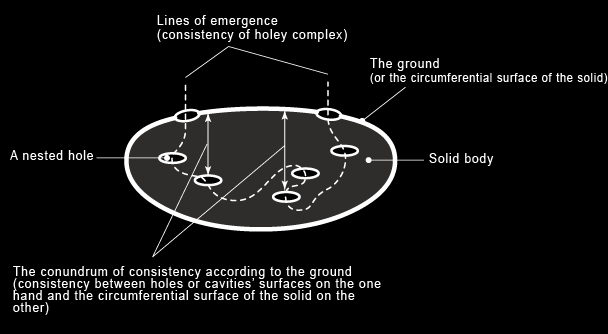
<p>If contemporary world politics inconsistently defies both holistic reading methodologies and their absence, then the Middle East to which global dynamics is blatantly flushed and from which confutations of global politics emerge entail the employment of new political analysis and intervention pragmatics. As an entity for which politics or political remobilization of its attributes precedes its geographical ontology, the Middle East should be approached or studied through methodologies which neither prioritize holistic models nor the destruction of such models. Accordingly, these models or methodologies should correspond to the socio-political formations of the Middle East for which structural or functional inconsistencies can only be addressed in a uniform way (i.e. consistently linked to each other) if they are to be taken in regard to a degenerative whole whose both partiality and wholeness are incapacitated and unable to exert control over each other. In a degenerative whole (<a href="http://hyperstition.abstractdynamics.org/archives/009759.html">previously referred to as ( )hole complex corresponding with the spatio-temporal unwholesomeness of Deleuze and Guattari’s holey space</a>), consistency of events and uniform dynamism exist and can only be discovered through a poromechanical space where differentiation between surfaces (as of holes) has paralyzed the eventuation of the ground as a prerequisite basis for formative forces. In fact, poromechanics where invocation of new grounds is registered as perforation of the formation by new surfaces (or holes) corresponds to multiplex governing forces in every Middle Eastern  State. Here the term <i>guerilla-state</i> [1] suits the Middle Eastern states or societies where the boundaries between the state and its others have already been terminally perforated.</p>]]>
<![CDATA[<p>Moreover and more importantly, despite the presence of merely one exclusive governing platform for the state (or head), the fundamental formation of Middle Eastern states are determined by multiple, often diverse or basically incompatible forces and political grounds. These political formations have to simultaneously establish their grounds inside and through the exclusive and ruling religio-political formation and abide by its ground. Unable to fully dismantle the hegemony of the state’s head formation or the ground, they attain a socio-political configuration which despite being in complicity with the governing ground, irreparably disrupts the ground’s ontological and functional consistency. By enacting their own political grounds, these political formations ontologically operate as surfaces which are not able to be registered as circumferential or visible surfaces; instead they are reinvented as subterreanean surfaces with their emergent holeyness and nested continuity. But nested continuity and holeyness effectuate a discontinuity which refuses to be ontological (in the manner of Leibnizian monads and scholastic entelechies) but rather exists as an interposition of gaps within a transcendental logic by which ontology of whole (even in terms of mereotopology) and differences can be traced or neatly isolated. While harboring the disruptions inherent to transcendence and logical ontology, nested continuity or holeyness develops a subterranean continuity or consistency that essentially undermines the consistency of the governing platform or political ground (i.e. ground as a visible, circumferential and superficial surface). The effectuation of these political grounds which by the virtue of a pre-dominant and pre-existing socio-political governing state have to continue to exist as subterranean surfaces is always in the direction of degeneration and incapacitation of the formation as a whole. As soon as the nestedness of holes emerge, the ground is only a shell or protective exoskeleton which politically feigns the autonomous subterranean consistency as superficial inconsistency. For this reason, poromechanics does not only commence the degeneration of whole as in the case of socio-political formations but also the utilization of such degeneration and corruption. In this sense, poromechanics bespeaks of decay and here a political one, because decay manifests as a limit process in which infinite putrefaction happens without triggering the complete ontological termination of the object. In decay, the object bears the burden of its ontology only to be a receptacle for the continuity of its material destiny which is knitted through perforation of boundaries and inconclusive holiness. The same can be said about a Middle Eastern political system for which formation can only exist on the level of superficial inconsistencies on the visible political ground.</p>

<p><center><img alt="Sponge.jpg" src="http://hyperstition.abstractdynamics.org/archives/Sponge.jpg" width="575" height="389" border="0" /></center></p>

<p><center>Image from Deleuze and Guattari’s <i>A Thousand Plateaus</i>. “The infinitely riddled Sierpinsky sponge would be one extreme model: all hole but with a ghoulish objectal insistence, the Idea of infinite rot.” (Robin Mackay, <i>On Reza Negarestani’s Undercover Softness</i>)</center></p>

<p>In the wake of political decay or disintegrating religious or political grounds, the application of global political orders, political analyses, theoretic and pragmatic confrontations (whether from the inside or the outside) have all proved hopeless or ineffective other than in contributing to the holeyness and convolution of the Middle East. The reason for this so-called failure – only pertinent in terms of their utilitarian and ultimately holistic efficiency – is dismissing or gleefully ignoring the processes and political dynamics at work in deteriorating the socio-political formations already emerged and established around the world. Here, the case is not the emergence of formations inherent to geo-politics of the Middle East as a geographic region of the earth with its own attributes to which world politics and contemporary political analyses are alien. The case is rather the realization of Middle Eastern political dynamics as processes emerging out of the <i>preexisting</i> political formations and the so-called global orders, processes which are inherent to deterioration and decay of such formations or orders. If the Middle East is geographically obscure, it is because it is really shared by world politics and orders, hence dissolving into the global continuum. Yet the Middle East is only connected to world politics as their own intensive collective destiny, that is to say, it is only shared by world’s political formations in decay and through a degenerative whole where no formative power can be effectively perpetuated. There is nothing more revolting for the vitalist ethos of the contemporary politics or global socio-political formations than to face their own degenerating and uncontrollably differentiating selves in the form of a geo-political obscurity named the Middle East. Today’s most inflexible, malfunctioning and inconsistent socio-political systems around the world can be presented as the inevitable unfolding of world’s dominant political formations through decay where the formation is nothing but a vehicle for anomalous recombinations and limitropic but perpetual differentiation. The seemingly literal depiction of this is the recurring portrayal of corpse in medieval culture, where human or animal carcass germinates outlandish animals and creatures which are only different from the original configuration through a gradient of porous and blurring boundaries. Yet this still is a teleonomic relief because according to medieval natural philosophy the form of an animal once it is a corpse can overlap with the form of another animal in life (cf. Henry of Langenstein). The latitudes of form associated to a decaying political formation, thus, can overlap with the latitudes of form belonging to a presumably integrated, wholesome or autonomous political system. The idea of truly collective political terror is insinuated here not only by the ability of a decaying political system in overlapping a reformative or even revolutionary politics but also the panorama in which a responsible and robust politics can in fact be the rottenest one. The Middle Eastern political dynamics is the realization of global political systems in their inevitability to be terminally collectivized and differentiated at last, namely, to decay. Although decay unfolds in the future as a material infinity circumscribed in the past (coinciding with the rise of the system or the birth of the object), yet its true channel is present where the object or system is assumed to have attained formative stability or establishment. Therefore in a more accurate sense of time, Middle Eastern political dynamics simultaneously separates from and returns to world’s political formations as their intensive destiny in decay. But in decay such a destiny is perpetual and limitropic, meaning decay will continue indefinitely in regard to a limit which is the ontological endurance of the object or system, even if it is the object in its most minimal and fundamental form. For this reason, the infinity of political decay is guaranteed by the persistence of world’s political formations. Yet more radically political, through decay, world’s politics is stripped to its bare foundations, that is to say, its most fundamental and vitally necessary traits – its ‘progressively becoming true’ form.              </p>

<p>The rigid but erratic incompatibility of Middle Eastern political systems to world politics corresponds with the existence of the Middle East as an obscure geographical region which narrates the collective and inconclusive destiny of global political systems whose in deterioration resist their original configuration but occasionally coincide with their former selves. This narration, however, cannot be conducted through a dominant plot or grounding socio-political platform but rather through the logic of decaying formations and degeneration of whole, or in other words, through what can be called plot holes. The obsession with relevancy or irrelevancy of a political analysis or pragmatics is the characteristic of a formation as a whole or dominant narrative plot where the distribution of consistencies and inconsistencies should always be consistent. For plot holes or degenerative political formations, relevancy as an extraneous access does not exist because the idea of a true relevant access to such poromechanical or deteriorating entities is only possible by adopting analyses conforming to their degenerating logic and perpetual mal-formations. By mimicking the porous logic of degenerative whole, the supposed relevant analysis cannot exist out of the idea of decaying or perforated formation where the distribution of consistencies does not follow a transcendental logic and thereby, relevancy enforces the breaks and fissures in transcendence. In short, either within the poromechanics of holey space or degenerative wholeness or decaying formation, relevancy is transcendentally nonexistent because it exists immanently by contributing to an unwholesomeness which presupposes the extinction of relevancy. Accordingly, relevancy becomes autophagic by taking a position which is participative in regard to its degenerative object which implements the lacunae of transcendence and consequently, the annulment of relevancy. In regard to a decaying political system or perforated formation, relevancy only exists immanently as an agent of participation through which the idea of a transcendental access (hence the dilemma of relevancy or irrelevancy) is profoundly confounded. </p>

<p>A narrative plot or a grounded politics always distributes narrative or political entities in a way to preserve its wholesomeness, a consistently (according to the ground that is) distribution of entities and events can generate formative forces which reinforce the whole. Since Middle Eastern political systems exemplify degenerative whole and the logics of poromechanics, methodologies for investigating the Middle Eastern dynamics must conform to their enigmatic logics and crypto-formation. We shall attempt to outline the elements required for modeling such methodologies by elaborating modes of analysis or reading which are based on defective structures, degenerative whole and poromechanics. In this regard, the literary genealogy of plot holes in writing will be elaborated in conjunction with peculiar archeological methodologies which themselves are utilized in contemporary Middle Eastern politics. To this end, literary theory of archeology and archeology of politics will constitute the next installment of this post.</p>

<p>[1] On guerilla-state, see <i>The militarization of peace</i> in Collapse vol. I, Oxford: Urbanomic, 2006.</p>]]>
</content>
</entry>
<entry>
<title>Poromechanics: archeology of psychoanalysis and militarization of archeology</title>
<link rel="alternate" type="text/html" href="http://hyperstition.abstractdynamics.org/archives/009759.html" />
<modified>2007-09-30T09:54:56Z</modified>
<issued>2007-09-30T09:54:56Z</issued>
<id>tag:hyperstition.abstractdynamics.org,2007://23.9759</id>
<created>2007-09-30T09:54:56Z</created>
<summary type="text/plain">The following text is a short excerpt from the lengthy paper discussed at the seminar on porous earth and subsurface politics. The lecture took place at Goldsmiths University of London and was organized by Eyal Weizman at the department of...</summary>
<author>
<name>R. Negarestani</name>
<url>http://www.cold-me.net</url>
<email>negarestani@cold-me.net</email>
</author>

<content type="text/html" mode="escaped" xml:lang="en" xml:base="http://hyperstition.abstractdynamics.org/">
<![CDATA[<p>The following text is a short excerpt from the lengthy paper discussed at the seminar on porous earth and subsurface politics. The lecture took place at Goldsmiths University of London and was organized by Eyal Weizman at the department of visual cultures. Eyal Weizman has recently published his work <i><a href="http://www.amazon.com/Hollow-Land-Israels-Architecture-Occupation/dp/1844671259">Hollow Land</a></i>, a <i>tour de force</i> on militarization of geodynamics and space which I will later talk about at length.  </p>

<p>During the talk, the following section was elaborated by examples on the logic of poromechanical distribution of consistencies and the employment of this logic in locating ancient necropolises, underground facilities and decoding steganographic texts or works of hidden writing. For keeping the text short and suitable for one post, I have skipped the examples used in this section. </p>]]>
<![CDATA[<p>Deleuze and Guattari’s holey space can be addressed both as an event and entity. As an event it demarcates the limitropic degeneration of a whole which never effectuates full annihilation or complete effacement (hence the nomenclature ( )hole complex) and for this reason it perpetuates a poromechanical decay whose incessant dynamism is maintained by differentiation between solid and void. As an entity, the holey space is characterized by its anomalous distribution of consistencies through the poromechanical space. </p>

<p>The politics of the holey space is defiant toward the existing models of harvesting power, manipulating and analyzing events on the surface. For the world order, inconsistent events around the world are failures or setbacks since they resist the contemporary dominant political models. According to the politics of poromechanical earth, however, inconsistencies, regional disparities and insidious nonuniformities across the globe constitute the body of the ultimate politics. The emergence of two entities (political formation, military, economic, etc.) from two different locations on the ground is inconsistent, but according to the logic of ( )hole complex they are terminally inter-connected and consistent. In terms of emergence, consistency or connectivity should not be measured by the ground or the body of solid as a whole but according to a degenerate model of whole and the poromechanical entity. <br />
 <br />
The asymmetry between ground’s consistency and the consistency of poromechanical entities or porous earth has long been formulated by military and political practitioners as an archeological law – <i>for every inconsistency on the surface, there is a subterranean consistency</i>. The law of subterranean cause in archaeology bears a striking resemblance to Freud’s suggestion that for every psychosomatic breakdown, there is a Complex (an anomalous convolution and knottedness) beneath consciousness. The reason for this similarity lies in the fact that according to both archeology and Freudian psychoanalysis, the line of emergence (the worm-function) travels according to the resistivity against emergence, the dynamism of emergence and degree of porosity. The course of emergence in any medium is identical to the formation of that medium; the more agitated the line of emergence becomes, the more convoluted and complex the host medium will be. In terms of poromechanics and ( )hole complex, the superficial orientation of both archaeology and Freudian psychoanalysis are too complex – immersed in multiplex dynamics of surfaces and their interactions with emergence – to be fathomed. The myths of obtuse flatness or totalitarianism attributed to Freudian psychoanalysis by postmodernist rivals are in most cases the symptoms of misunderstanding the problem of surfaces and emergence as related to the lacunae of consciousness. The superficial (as related to visible, circumferential and grounded surfaces) entities of Freudian theories only come into existence as products of unbound activities in emergence, or more accurately, the convoluted and porous formations through which emergence takes place. In the domain of emergence, every surface – whether of constraining ground or porosities – belongs to and is mobilized by the poromechanics of ( )hole complex. And in ( )hole complex, depth exists as the ambiguity or the gradient between inner and outer, solid and void, one and zero; or in other words, as a third scale or a dynamically balancing, intermediary agency which operates against the unitary or binary logics of inner and outer, vigor and silence, inclusion and exclusion. Holes spontaneously develop a ternary logic.  </p>

<p>For both archaeology and Freudian psychoanalysis, the process of emergence and its immediate connection with formation and dynamism of surfaces, namely, ( )hole complex inevitably coincides with paranoia. For every inconsistency on the surface, there is a subterranean consistency; here is an overlap between two consistencies. One is the consistency according to the dynamic surfaces of holey space or simply cavities, and the other is the consistency between cavities surfaces (holes) and the circumferential surface of the solid (ground or visible surface). For every cause with a vertical distribution, there is a cause with a horizontal or slanted distribution, or vice versa. The effect is simultaneously produced by two causes with two different logics. For being registered on the circumferential surface or the ground, the schizoid structure or consistency of ( )hole complex should be transmitted to the solid body where it has to be consolidated. Anomalies on the ground-surface are imminent to the two planes of schizophrenia and paranoia. According to the archeological law of contemporary military doctrines and Freudian psychoanalysis, for every inconsistency or anomaly on the ground, there is a schizoid consistency; to reach the schizoid consistency, a paranoid consistency or plane of paranoia must be traversed. (See Fig. 13) </p>

<p><center><img alt="poromechanical reasoning" src="http://hyperstition.abstractdynamics.org/archives/reasoning.gif" width="608" height="334" border="0" /><br />
</center></p>

<p><center>Fig. 13 The two planes of schizophrenia and paranoia: subterranean consistency and superficial inconsistency</center></p>

<p>The militarization of the contemporary world both in its politics and concrete approaches is architecturally, visually and psychologically paradoxical (too paranoid to be schizoid and too schizoid to be paranoid); since its agencies – as of in War on Terror – are shifting from the logic of grounded earth to the poromechanical earth and the logic of hole agencies. Although making examples restricts the vastness of militarization in respect to the poromechanics of war and archeology as the science of military innovation in the twenty-first century, but enumerating one or two cases might increase lucidity.</p>

<p><b>1</b>. In countries with detailed homeland security protocols or relatively high level of alertness, where ground or aerial operations as of hostile, subversive or stealth activities cannot be conducted, the emergence of intricate poromechanical entities is escalated and cannot be avoided. In such countries, the distribution of illegal immigrants or smuggled products such as drugs and weapons around the border regions follows not patterns of activities on the surface but the formation and the architecture of nested holeyness beneath the ground. Activities or lines of movement (tactics) are not separate from the architecture of such ( )hole complexes. According to military experts or urban planners with military educations, criminal and hostile activities can no longer be explained, analyzed or traced on land, aerial and water levels. These activities only conform to (paranoically that is) structures of vast underground vermiculate spaces and their constantly displacing lines of emergence (schizoid formations of surfaces). The distribution, escalation and diffusion of complicities is identical to different aspects of hole trafficking. For military experts, the terror market is nothing but that of porosities of earth. Cross-border wormholes under the US-Mexico border, tunnels under Gaza-Egypt and all other examples of hole trafficking confound the polarities of surface globalization and its politico-military facets. Economic and power formations for clandestine Guerilla-states, anti-State movements and ambiguously Imperialist states configure themselves on poromechanics of war.         </p>

<p><b>2</b>. The Battle of Tora Bora in Afghanistan mainly escalated by coalition forces (especially US forces to the point of using BLU-82 bombs and a potential nuclear bunker buster strike) based on the collected information about vast underground facilities and terror networks in Tora Bora Mountains. US and British forces initiated a surgical strike comprised of sophisticated tactics, innovative command and control and inventive use of military implements and weapons. Tactics and the entire logic of military progression in Tora Bora were formulated precisely in order to match the mountains, and give an appropriate military response to the holey architecture of terror compounds. In short, the military formation of the entire battle was determined based on the supposed tortuousness of the holey complex within the mountains, and then techniques and solutions for neutralizing and clearing them. The complexity of movements or formative dynamics belonging to US and British forces was compatible and in counter-geographical correspondence to the nested complexity of holes, tunnels and underground chambers. The Battle of Tora Bora was actualized based on the complexity of Tora Bora sub-surface facilities but in the absence of actual holes and vermiculate complexities. Bound to the paranoid logical line in holey complexes (from the ground to the cavity) and unbound by a nonexisting schizoid architecture of nested holes, coalition forces led by United States developed the first full-fledged example of Cappadocian Complex. Adhering to the logic that wherever hostile activities and threats are inconsistent and asymmetrical, there is an underground cause of nested holeyness; and consequently one must formulate formations to counteract these convoluted and subterranean architectures is the heart of Cappadocian Complex. Where in <a href="http://www.edwardjayepstein.com/nether_fictoid3.htm">Tora Bora</a>, there was no sub-surface nexus or complex, in Cappadocia beneath every surface and in every mountain or hill there is a multiplex of holes, lairs and passageways, an elusive machine digging in and out. </p>

<p>Poromechanics is simultaneously construed by the vector of schizophrenia and the vector of paranoia. For contemporary world politics, militarization is inevitably determined by the differentiation between these two vectors. </p>

<p><center><img alt="the Cappadocian Complex" src="http://blog.urbanomic.com/cyclon/archives/Cappadocian_Complex.jpg" width="400" height="728" /></center></p>

<p><center>Cappadocia, Avanos Valley</center></p>]]>
</content>
</entry>
<entry>
<title>COLLAPSE: Numeric Materialism, Speculative Realism, Unknown Deleuze</title>
<link rel="alternate" type="text/html" href="http://hyperstition.abstractdynamics.org/archives/009747.html" />
<modified>2007-09-25T08:28:53Z</modified>
<issued>2007-09-25T08:28:53Z</issued>
<id>tag:hyperstition.abstractdynamics.org,2007://23.9747</id>
<created>2007-09-25T08:28:53Z</created>
<summary type="text/plain">In case the new announcement for Collapse III hasn&apos;t reached the dark side of the Net, you might be interested to take a look at its table of contents and even consider ordering it. Since the first issue (Numeric Materialism),...</summary>
<author>
<name>R. Negarestani</name>
<url>http://www.cold-me.net</url>
<email>negarestani@cold-me.net</email>
</author>

<content type="text/html" mode="escaped" xml:lang="en" xml:base="http://hyperstition.abstractdynamics.org/">
<![CDATA[<p>In case the new announcement for Collapse III hasn't reached the dark side of the Net, you might be interested to take a look at its table of contents and even consider ordering it. Since the first issue (Numeric Materialism), Collapse has proved to be an outstanding journal of philosophy which simultaneously defies the swamps of academia and rigorously ravages the overpopulated territories of post-structural / post modernist theories. For those who are solely interested in hyperstitional and political themes, Collapse I has articles on Qabalah, Prime Numbers and desert war machines traversing War on Terror, including an utterly compelling essay by Nick Land. Collapse II has two articles which stand out among the rest of contributions: Quentin Meillassoux and Ray Brassier's essays. Brassier's essay scrutinizes -- in a technical and superbly literate way -- the enigma of realism and an alternative causality capable of perforating the real. It is a piece which silently exudes a Lovecraftian dilemma on reality and intelligibility in regard to cosmic abyss (realism of horror). Collapse III (the forthcoming issue, Unknown Deleuze) is, as it confesses, a remobilization of Deleuze's thought against the specter of a post-Deleuzian era and a philosophic age choked by the reckless fecundity of Deleuzians. In addition, Collapse III includes two previously unpublished English translations of Deleuze and a science-fiction story by J.-H. Rosney the Elder who elusively lurks in Difference and Repetition. Whereas Lovecraft and Professor Challenger expose the undertones of A Thousand Plateaus, Rosney and Doctor Van den Heuvel (absent in Deleuze's book) encapsulate the themes presented in Difference and Repetition. The term Inverse-Lovecraft rightly suits Rosney. Collapse III also includes the full transcription of the Speculative Realism conference at Goldsmiths University of London. The document features a fresh appearance from Iain Hamilton Grant who has been working on his now complete infernal machine, <i>On Artificial Earth: Philosophies of Nature after Schelling</i>. The Speculative Realism document is particularly important for a thoroughgoing discussion on horror, realism, causality and the truth of extinction.  </p>

<p><a href="http://blog.urbanomic.com/urbanomic/"><b>Collapse III: Unknown Deleuze</b></a><br />
</p>]]>

</content>
</entry>
<entry>
<title>Language of the Pest</title>
<link rel="alternate" type="text/html" href="http://hyperstition.abstractdynamics.org/archives/009744.html" />
<modified>2007-09-24T08:31:46Z</modified>
<issued>2007-09-24T08:31:46Z</issued>
<id>tag:hyperstition.abstractdynamics.org,2007://23.9744</id>
<created>2007-09-24T08:31:46Z</created>
<summary type="text/plain">This is part of the text for one my three talks earlier this year in London. In contrast to the other papers this is very short so I deemed it appropriate for hyperstition especially because it is a brief retrospection...</summary>
<author>
<name>R. Negarestani</name>
<url>http://www.cold-me.net</url>
<email>negarestani@cold-me.net</email>
</author>

<content type="text/html" mode="escaped" xml:lang="en" xml:base="http://hyperstition.abstractdynamics.org/">
<![CDATA[<p>This is part of the text for one my three talks earlier this year in London. In contrast to the other papers this is very short so I deemed it appropriate for hyperstition especially because it is a brief retrospection on discussions we have had on hyperstition regarding alphabets, sounds, txts and other teratological components of Middle Eastern writing systems as mobilized by socio-political dynamics. The original paper contained two sections, barbaric tongues and their shape of writing. This post features the first part of the paper – barbaric music. </p>]]>
<![CDATA[<p><b>Barbaric Music and Vowelless Alphabets</b></p>

<p>To call a population barbarian is to measure their vocalization perceptually and sometimes quantitatively as noise; roar, shriek, howl, ululation, bark, yelp, wail, a lupus orchestra, a constant vociferation of the language. The Greeks and the Romans’ vigilance against the uncivilized was not originally denoting or aiming at the way of living or the form of architecture but rather the foreign vocalization of people who were marked as savage, ill-bred and uncivilized. For the Greeks, the savages were the ones who vocalized consonants non-linearly, those whose vocalization turn the language to gibberish, harmonized sounds to noise, the divinity of the Word to demonized outcry. Savage languages transformed the serene facial traits which were of the Greek face (a face which was the face of a politician, a philosopher, a militant all at the same time) and were shaped by vocalization into insensate, heathen, bestial and inhuman faces and not merely facial expressions of a profound savagery. The word <i>barbaros</i> or barbarian as the foreign savage attests to the Greeks’ most fundamental criterion for addressing one’s distance or gap from the civilized world and cultured populations. This indisputable measure for scaling one’s civility was, in fact, vocalization (i.e. adding vowels to unheard-of consonants and alien utterance). To this extent, speakers of Semitic and African languages could be categorized as barbarians or those whose vocalization and speech can only be detected as the bar sound (i.e. the bar-bar sound), or the sound similar to the emphatic repetition of the tap sound (tap-tap), expressing the b sound and mapping its characteristics. In mammals’ territory, when the process of vocalization or harmonizing noise functions as a means of communication, noise can be found both at the background or as an additive element – combined with vocality – to vocalization. For the Greeks as well as the Romans, barbarians were those who could be understood if only their speech is translated to the bar-bar sound. Such foreigners transform the pleasance of hearing or speech as the divine senses for sympathy to the antipathetic feeling of nausea (<i>N&#945;&#965;&#964;&#949;&#943;&#945;</i>) accompanied by vertigo, vomit, ear drainage, dizziness and the sensation of spinning and loss of equilibrium. According to the Greeks, listening to barbarians results in an alien sensation called <i>N&#945;&#965;&#964;&#949;&#943;&#945;</i> or more accurately, something profoundly wrong in the ear caused by the confusion between the actual movement (actual vocalization process used by a barbarian) and perceived movement (what can be heard from that barbaric vocalization in the Greek language), and also movements in different directions which were the characteristics of the noise (nausia) made by barbarian vocalization in the Greek language and phonetic system. For the Romans, likewise, the barbarity of vocalization was a touchstone to determine the quality and value of culture, social dynamics as well as motivations and alignments of people with Roman civilization, bureaucratic pantheon of gods and their political system. In the course of a mass slaughter of a tribe or a village populated by the ‘foreign vocalizers’ (mostly of Semitic and African languages) known as barbarians, Romans frequently referred to the utterances of outlanders during escape, battle and emotional arousal as ruckus and demonic dissonance (<i>dis-sonare</i>) or disjointed sound as what lacks the orderly structure of Roman dance music (<i>&#959;&#961;&#967;&#942;&#963;&#964;&#961;&#945;</i>) whose boisterousness was demonstrated in its militant order and bloodied ecstasy. </p>

<p>For the Roman soldier it was an ethical responsibility to give the demon imprisoned in the throat and oral cavity of the barbarian an outlet to flee by cutting the throat or the head of the savage. A humanitarian act whose consequence might drive the soldier insane as the result of the last unintelligible shriek which the demon made, the exclamation noise rooted and formed by a vocalization process whose even systematic communicative units such as sentences are considered as noise. Romans had bizarre tales about barbarians who were stalking in the outlands and transmogrified by a severe felinity. Romans justly called them cat people, a title which was indeed accurate; for speaking with languages constituted of vowelless alphabets causes an excessive vocalization – or sophisticated phonetic systems and vocalizations – which is the mark of cats and felidae. The Samaritans, the people of Arabic peninsula and even western borders of Persia were frequently addressed as Dung People, not because of malodors fermented under the scorching sun of the Near and Middle Eastern regions but because of the noise they emanated which belonged to the unorchestral body of Beelzebub, the Lord of Flies: I romp around with the sound of flies. </p>

<p>The barbarians who could be distinguished by translating all they vocalized to the bar-bar sound by the Greeks and Romans were exactly those people whose vocalization process was not really dominated by the bar-bar sound (which is of the b or &#946; sound). In fact, the Greek and Roman languages were monomaniacally haunted by the b sound. Betarrhea – or the abnormal flow of the Beta sound to other consonants and the way they are vocalized – was always exclusive to both empires and their citizens. </p>

<p>Vocalization of vowelless alphabets (as of Semitic languages) or barbaric music can never be grasped entirely through sounds with pulmonic egressive initiation in which the air stream is created by lungs (pulmo) and releasing or pushing out (egression) the air, but rather different initiation mechanisms. In these vocalization mechanisms, in contrast to pulmonic egression, air flow is generated through the vocal tract such as glottalic (through glottis) and veralic (through velum), and not only pulmonic (through lung). In Greek and Roman languages – unlike Semitic and African languages – the majority of sounds are both pulmonic and egressive akin to the airflow initiation of the b sound, or to be exact, the real bar-bar sound. However, in Semitic languages as the most contractible languages in the Middle East, consonants can be vocalized not only by being initiated from the lungs to the lips but also as nonlinear blasts, thus, not satisfying the originally Greek fetishism with the Beta sound. The initiation mechanism of &#946; as pulmonic egressive is categorized as the airflow mechanism primarily involved in producing the consonantal sound of the b or beta sound which is ‘voiced bilabial plosive’, or in other words, the b sound mostly denotes and comes from the voiced bilabial plosive sound). Painlessly utterable, the voiced bilabial plosive is a consonantal sound which can be easily mapped by its eschatological tendency towards definite stoppage and its stubborn linearity. While it is created through stopping – plosive – or obstructing airflow in the vocal tract (the manner of articulation), it is initiated through lungs and is articulated by both lips, a route directorially linear and facially civilized in conclusion – the Greek Face. </p>

<p>The Greek aesthetics, as opposed to the Middle Eastern ominousity, has been established on this linear route from lungs to both lips as the territory of an articulation so audacious and impeccable that it is only matching the cold efficiency of lips on the face capable of articulating everything in the same manner and political demeanor. If the Greek and Latin busts bear the majestic beauty of Greek and Latin faces even during the most heated lectures, quarrels, battles and adventures, it is because the lips and eyes (as the addendums of articulation) as the pivots of expression are fully used on a simplistically linear route. The Greek and Roman faces demonstrate the suppression of the linear pulmonic egressive mechanism with a sense of a crude realism one can only expect from a barbarous art. </p>

<p>No art takes the harsh realism of the vocalization process involved in creating standards of its facial beauty as serious as Greek and Latin art; but to this extent, one can hardly speak of standards as in these cultures there is only one facial expression as the inspiring element of beauty. And this facial expression is triggered only by one dominant articulation process, the sole process they were capable of and out of which the standards of civilization and barbarity were determined. For the Romans, having a vermin face was intrinsic to Middle Eastern vocalization. Exquisitely Greek and Latin, the iconographic face of Jesus of Nazareth who spoke in Aramaic ironically sympathizes with the Latin and Greek facial aestheticism, the cold serenity originating from their inflexible vocalization process and linear articulation of consonants. But the Aramaic language with its insidious sophistication both in writing and phonetic systems can only render the face of a carcass (for the consonants which are fully vocalized internally without being concluded by the lips) or a face of thousands of spasms (for the articulation process which non-linearly twitches the whole face in different directions) during vocalization. All Christianity wants is a Roman savior, but we speak with the face of a brute. </p>

<p><center>---------</center></p>

<p>If there is an accurate western media, it is essentially on the side of terror because it has to abide by vocalization, pronunciation systems and spelling relevancy that only exists on the side of terrorists. The more irrelevant the pronunciation, the more civilized the speaker is; because it will have less in common with the original pronunciation which can only be vocalized by a Middle Eastern terrorist. In the case of pronouncing a name like Ghatar [Qatar] starting with the letter Ghaaf which defies English vocalization, the pronunciation ‘guitar’ is remote enough to be civilized but the proposed pronunciation ‘gutter’ is so far off that it signifies the zenith of western civilization.   </p>]]>
</content>
</entry>
<entry>
<title>Dino Power</title>
<link rel="alternate" type="text/html" href="http://hyperstition.abstractdynamics.org/archives/009637.html" />
<modified>2007-08-13T05:06:55Z</modified>
<issued>2007-08-13T05:06:55Z</issued>
<id>tag:hyperstition.abstractdynamics.org,2007://23.9637</id>
<created>2007-08-13T05:06:55Z</created>
<summary type="text/plain"> Michael Barone gets the politics of trade restriction exactly right....</summary>
<author>
<name>Old Nick</name>

<email>ccru00@hotmail.com</email>
</author>

<content type="text/html" mode="escaped" xml:lang="en" xml:base="http://hyperstition.abstractdynamics.org/">
<![CDATA[<p><img alt="Aflcio.jpg" src="http://hyperstition.abstractdynamics.org/archives/Aflcio.jpg" width="300" height="200" border="0" /></p>

<p>Michael Barone gets the <a href="http://www.realclearpolitics.com/articles/2007/08/free_trade_will_past_trump_fut.html">politics of trade restriction</a> exactly right.</p>]]>

</content>
</entry>
<entry>
<title>Colossal Vulnerabilities</title>
<link rel="alternate" type="text/html" href="http://hyperstition.abstractdynamics.org/archives/009636.html" />
<modified>2007-08-13T04:50:40Z</modified>
<issued>2007-08-13T04:50:40Z</issued>
<id>tag:hyperstition.abstractdynamics.org,2007://23.9636</id>
<created>2007-08-13T04:50:40Z</created>
<summary type="text/plain">John Robb&apos;s analysis of the threats arising from technological runaway leads to a long-anticipated strategic conclusion: Effective defense demands the dismantling of Leviathan....</summary>
<author>
<name>Old Nick</name>

<email>ccru00@hotmail.com</email>
</author>

<content type="text/html" mode="escaped" xml:lang="en" xml:base="http://hyperstition.abstractdynamics.org/">
<![CDATA[<p>John Robb's <a href="http://www.city-journal.org/html/17_3_urban_terrorism.html">analysis</a> of the threats arising from technological runaway leads to a long-anticipated strategic conclusion: Effective defense demands the dismantling of Leviathan. </p>]]>
<![CDATA[<p>One striking way-station in Robb's argument:</p>

<p><i>University of Washington engineer Robert Carlson observes that if current trends in the rate of improvement in DNA sequencing continue, “within a decade a single person at the lab bench could sequence or synthesize all the DNA describing all the people on the planet many times over in an eight-hour day.”</i></p>]]>
</content>
</entry>
<entry>
<title>Overtaken by Time</title>
<link rel="alternate" type="text/html" href="http://hyperstition.abstractdynamics.org/archives/009616.html" />
<modified>2007-08-07T02:14:25Z</modified>
<issued>2007-08-07T02:14:25Z</issued>
<id>tag:hyperstition.abstractdynamics.org,2007://23.9616</id>
<created>2007-08-07T02:14:25Z</created>
<summary type="text/plain"> OK, Gibson always said the future was already here (&quot;it&apos;s just unevenly distributed&quot;), but according to this interview, his new novel Spook Country is set in the near past. Does that mean, as Glenn Reynolds asks, that we&apos;ve already...</summary>
<author>
<name>Old Nick</name>

<email>ccru00@hotmail.com</email>
</author>

<content type="text/html" mode="escaped" xml:lang="en" xml:base="http://hyperstition.abstractdynamics.org/">
<![CDATA[<p><img alt="Gibson0.gif" src="http://hyperstition.abstractdynamics.org/archives/Gibson0.gif" width="319" height="240" border="0" /></p>

<p>OK, Gibson always said the future was already here ("it's just unevenly distributed"), but according to <a href="http://www.silicon.com/silicon/networks/webwatch/0,39024667,39168006-1,00.htm">this</a> interview, his new novel <i><a href="http://www.amazon.com/Spook-Country-William-Gibson/dp/0399154302/ref=pd_bbs_sr_1/102-8872906-5848135?ie=UTF8&s=books&qid=1186453073&sr=1-1">Spook Country</a></i> is set in the near past.</p>

<p>Does that mean, as Glenn Reynolds <a href="http://instapundit.com/archives2/007904.php">asks</a>, that we've already crossed over "into the Singularity?"<br />
</p>]]>
<![CDATA[<p>Gibson:</p>

<p><i>The trouble is there are enough crazy factors and wild cards on the table now that I can't convince myself of where a future might be in 10 to 15 years. I think we've been in a very long, century-long period of increasingly exponential technologically-driven change.</p>

<p>We hit a point somewhere in the mid-18th century where we started doing what we think of technology today and it started changing things for us, changing society. Since World War II it's going literally exponential and what we are experiencing now is the real vertigo of that - we have no idea at all now where we are going.</i></p>

<p>And from the Amazon link:</p>

<p><i><b>Amazon.com</b>: So do you think that's your own career path, that you're less interested in imagining a future, or do you think that the world is changing? </p>

<p><b>Gibson</b>: I think it's actually both. Until fairly recently, I had assumed that it was me, me being drawn to use this toolkit I'd acquired when I was a teenager, and using my old SF toolkit in some kind of attempt at naturalism, 21st-century naturalistic fiction. But over the last five to six years it's started to seem to me that there's something else going on as well, that maybe we're in what the characters in my novel Idoru call a "nodal point," or a series of them. We're in a place where things could just go anywhere. </i></p>]]>
</content>
</entry>

</feed>